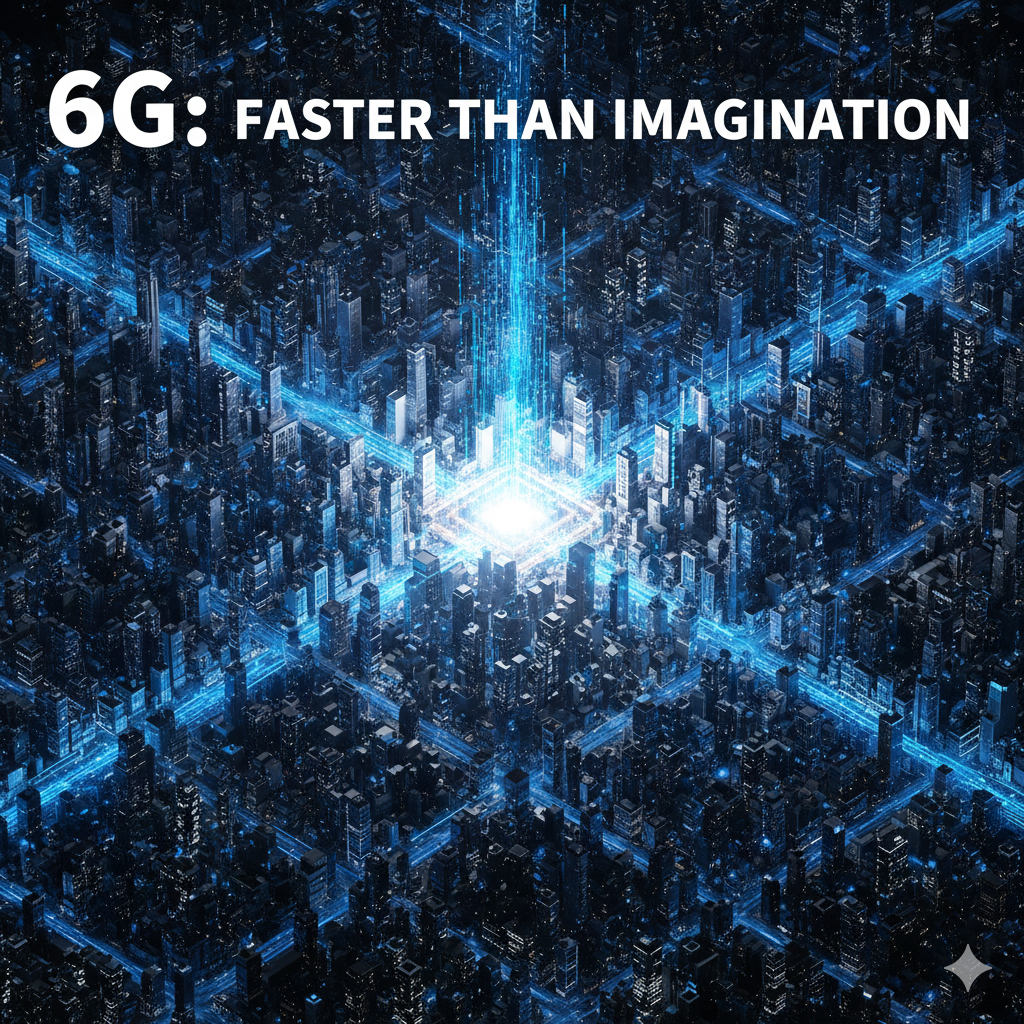
Just as the world was settling into the high speeds of 5G, the horizon of 2026 has revealed a new paradigm of connectivity: **6G**. This is not merely a step up from its predecessor; it is a total leap into a world of hyper-speed and near-zero latency. 6G is designed to be **Faster Than Imagination**, moving beyond the gigabit era into the terabit era. With the potential to deliver speeds 100 times faster than 5G, 6G is the foundational technology that will power autonomous cities, holographic communication, and the Internet of Bodies. In 2026, the internet is no longer something we “connect to”—it is a seamless, intelligent fabric that permeates the physical world.
The Science of 6G: Terahertz and AI-Native Networks
The core breakthrough of 6G lies in its utilization of the **Terahertz (THz) spectrum**. While previous generations relied on sub-6 GHz and millimeter-wave frequencies, 6G pushes into the much higher THz range. These frequencies provide massive bandwidth, allowing for the transmission of data at rates exceeding 1 Terabit per second (Tbps). This means you could download hundreds of 4K movies in a single second. However, because these waves have a short range, 6G relies on a dense network of “Micro-Cells” and intelligent surfaces that can reflect and steer signals around obstacles.
AI-Native Architecture
Unlike 5G, which integrated AI as an add-on, 6G is **AI-Native**. The network itself is managed by autonomous AI agents that optimize signal strength, predict traffic congestion, and manage power consumption in real-time. In 2026, the 6G network is self-healing; if a transmitter fails, the AI immediately reroutes the data through a swarm of low-earth orbit satellites or nearby IoT devices, ensuring that connectivity is never lost, even in the most remote locations.
Sub-Millisecond Latency: The End of Delay
The most revolutionary aspect of 6G is its latency—or lack thereof. 6G aims for a latency of less than 0.1 milliseconds. This is essentially “Zero Latency” in human terms. This speed is critical for applications that require instantaneous feedback, such as remote robotic surgery, where a surgeon in New York can operate on a patient in London with no perceptible delay, or for synchronized swarms of autonomous drones managing urban logistics.
The Impact: Holographic Communication and the Metaverse
In 2026, 6G is transforming how we communicate. Video calls are being replaced by **Holographic Telepresence**. Because 6G can handle the massive data required for high-fidelity 3D rendering in real-time, you can now project a life-sized, photorealistic hologram of a person into your room. This is the ultimate realization of the Metaverse—not as a cartoon world, but as a blended reality where digital presence is indistinguishable from physical presence.
The Internet of Senses
6G is also enabling the “Internet of Senses.” Through advanced haptic feedback suits and neural interfaces, users can not only see and hear a digital environment but also feel textures, perceive temperature, and even detect scents. This multi-sensory connectivity is revolutionizing training, entertainment, and emotional connection, allowing people to “be there” without ever leaving their homes.
Autonomous Mobility and Smart Cities
The safety of flying taxis and self-driving trucks in 2026 depends entirely on 6G. For thousands of fast-moving vehicles to communicate with each other and with city infrastructure, the network must be ultra-reliable. 6G provides the “Collective Intelligence” required for a smart city to function as a single organism, optimizing energy use, managing traffic flow, and ensuring that accidents become a relic of the past.
Global Competition and Spectrum Sovereignty
The race for 6G supremacy is a major geopolitical focus in 2026. Nations are competing to set the global standards and secure the necessary patents. This is not just about speed; it is about **Spectrum Sovereignty** and national security. The country that masters 6G first will lead the global economy for the next decade, as 6G becomes the backbone of all industrial, military, and social infrastructure.
The Green 6G Initiative
A major concern for the 6G era is energy consumption. Transmitting data at THz speeds requires significant power. In 2026, the “Green 6G” initiative is focused on using energy-harvesting sensors that can run without batteries, powered by ambient radio waves. This sustainable approach ensures that the hyper-connected world of the future does not come at an environmental cost, making 6G the most eco-friendly network in history.
Conclusion: Navigating the Terabit Future
6G is more than just a faster internet; it is a fundamental shift in the human experience. By providing a network that is faster than imagination, we are unlocking the potential for innovations we haven’t even conceived of yet. As we move forward into 2026 and beyond, 6G will continue to dissolve the boundaries between people, places, and things. We are entering an era of absolute connectivity, where the collective knowledge and power of humanity are available to everyone, everywhere, at the speed of thought. The future is fast, it is intelligent, and it is 6G.