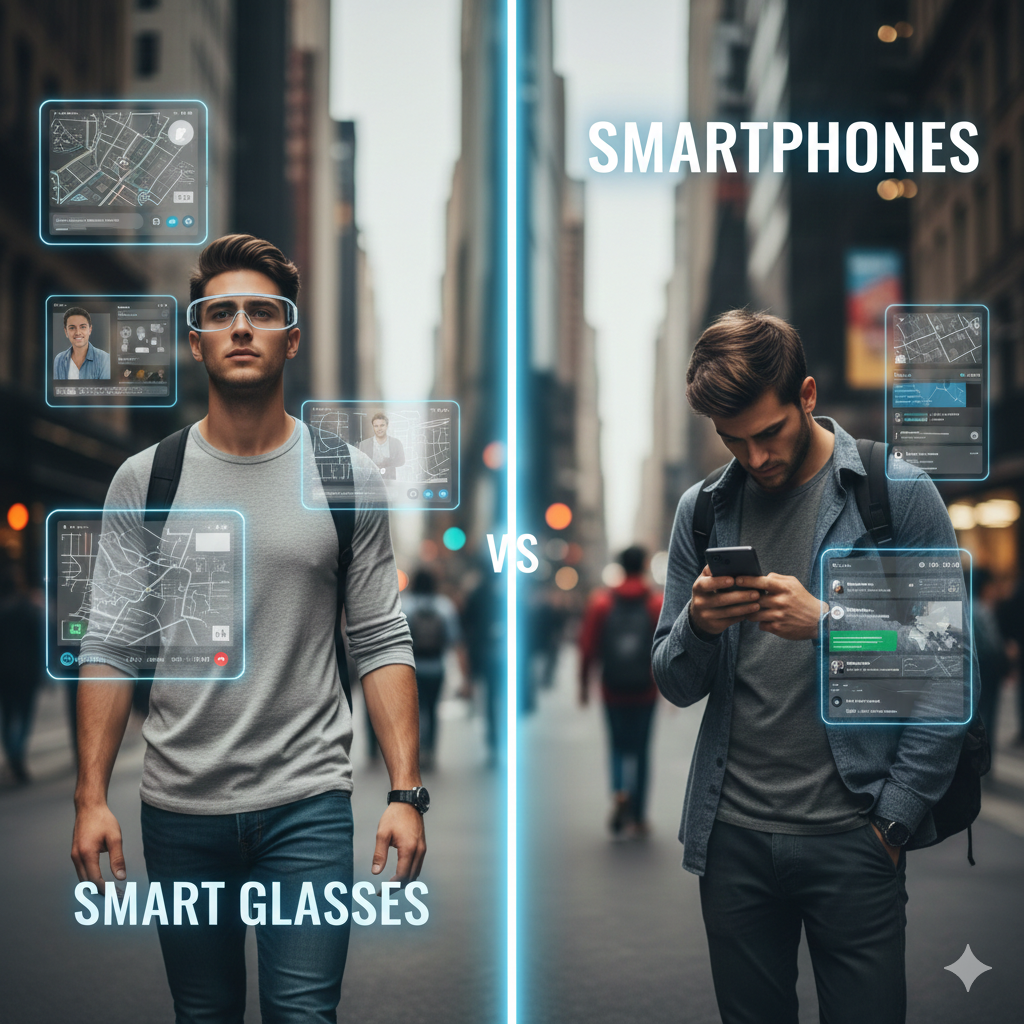
For nearly two decades, the smartphone has been the center of our digital universe. It has been our map, our bank, our camera, and our social hub. But as we move through 2026, a seismic shift is occurring in personal computing. The era of the “Screen in Your Pocket” is being challenged by the era of the “Screen on Your Eyes.” **Smart Glasses**, powered by advanced Augmented Reality (AR) and AI, are no longer clunky prototypes; they are sleek, high-performance devices that threaten to make the smartphone obsolete. The battle between Smart Glasses and Smartphones is more than a tech rivalry—it is a struggle between looking down at a glass slab and looking up at the world.
The Downfall of the Handheld Screen
The smartphone, despite its brilliance, has a fundamental design flaw: it demands your hands and your downward gaze. This has led to the phenomenon of “text neck” and a growing sense of digital disconnection from the physical world. In 2026, users are increasingly seeking “Heads-Up” experiences. Smart Glasses solve this by overlaying digital information—notifications, navigation, and video calls—directly onto your field of vision, allowing you to remain present and engaged with your surroundings while staying connected.
Augmented Reality: Information in Context
The true power of Smart Glasses lies in **Contextual Computing**. A smartphone can show you a map of the city, but Smart Glasses can project a virtual blue line on the actual sidewalk in front of you. When you look at a restaurant, the glasses can hover a 4.5-star rating and the daily specials right over the door. This ability to merge digital data with physical objects in real-time makes the smartphone’s flat, 6-inch display feel like an ancient, limited window.
AI-Driven Visual Assistance
Modern Smart Glasses are integrated with advanced AI agents. In 2026, these glasses don’t just show you data; they understand what you see. If you are fixing a car engine or assembling furniture, the AI can identify the parts and project 3D instructions directly onto the workspace. This hands-free assistance is a game-changer for productivity, transforming the glasses from a communication device into a master-level skill multiplier.
Technological Breakthroughs of 2026
What changed to make Smart Glasses a viable smartphone replacement? Three major technological hurdles were cleared in the last 24 months: Battery Efficiency, Waveguide Optics, and Neural Interfaces.
1. Waveguide Optics and Micro-LED Displays
Early AR glasses were bulky and had poor visibility in sunlight. The 2026 generation utilizes advanced **Waveguide Optics** combined with Micro-LED projectors. This technology allows the lenses to be as thin as standard prescription glasses while delivering high-brightness, crystal-clear 4K overlays even in direct midday sun. The “screen” is now invisible to everyone but the wearer, maintaining a natural appearance in social settings.
2. The Move to Edge Computing and 6G
Processing high-resolution AR requires massive power. Instead of stuffing a hot, heavy processor into the glasses’ frames, 2026 Smart Glasses utilize the low-latency power of **6G networks** and **Edge Computing**. The heavy processing is done on nearby servers or a small “compute puck” in your pocket, allowing the glasses to stay cool, lightweight, and fashionable for all-day wear.
3. Neural and Gesture Interaction
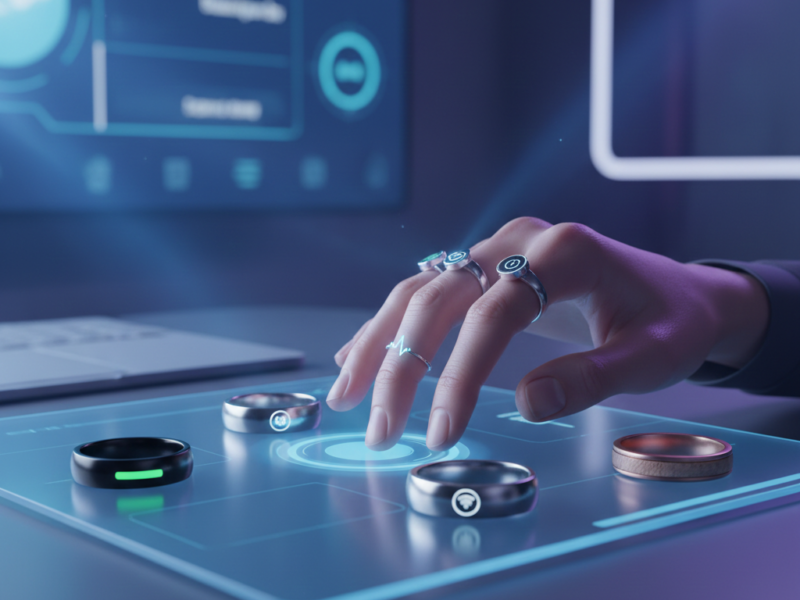
One of the biggest questions was: “How do you control them without a screen?” The answer arrived in the form of **Neural Wristbands** and **Eye-Tracking**. By detecting the micro-electrical signals in your wrist, you can click, scroll, and type in the air with minimal movement. Combined with eye-tracking that knows exactly where you are looking, the interface becomes intuitive and nearly invisible to bystanders.
The Privacy and Social Ethics Debate
The shift to face-worn cameras and microphones has not been without controversy. In 2026, the tech industry has implemented strict “Privacy Indicators”—visible lights that signal when a camera is active. However, the debate over “Digital Manners” continues. Is it polite to wear smart glasses during a dinner date? How do we protect public spaces from constant recording? Your website’s focus on these ethical frontiers is crucial for providing the trustworthy, in-depth content that global readers seek.
Digital Sovereignty and Data Privacy
As Smart Glasses record everything we see and hear, data security has moved from a “feature” to a “human right.” The leading devices of 2026 use **On-Device Encryption** and decentralized storage, ensuring that your visual memories and personal data are not accessible to big tech corporations without explicit, session-based consent. This focus on privacy is the only way Smart Glasses can gain the mass-market trust required to fully replace the smartphone.
The Future: A Post-Phone World
As we look toward 2030, the “Smartphone” will likely become a secondary device, acting merely as a portable hard drive or power bank for our wearables. Smart Glasses are the new primary interface for human-computer interaction. We are moving toward a world of “Ambient Computing,” where technology is always present but never in the way. The battle is over; the face has won.
Conclusion
The transition from Smartphones to Smart Glasses is the final step in the miniaturization of technology. By removing the physical barrier of a handheld screen, we are reclaiming our posture, our attention, and our presence in the real world. Smart Glasses offer a future that is more connected yet more human. As the pioneers of 2026 adopt this technology, we are witnessing the birth of a new digital era—one where the world is the screen and our eyes are the cursor. The future is looking bright, and it’s right in front of us.