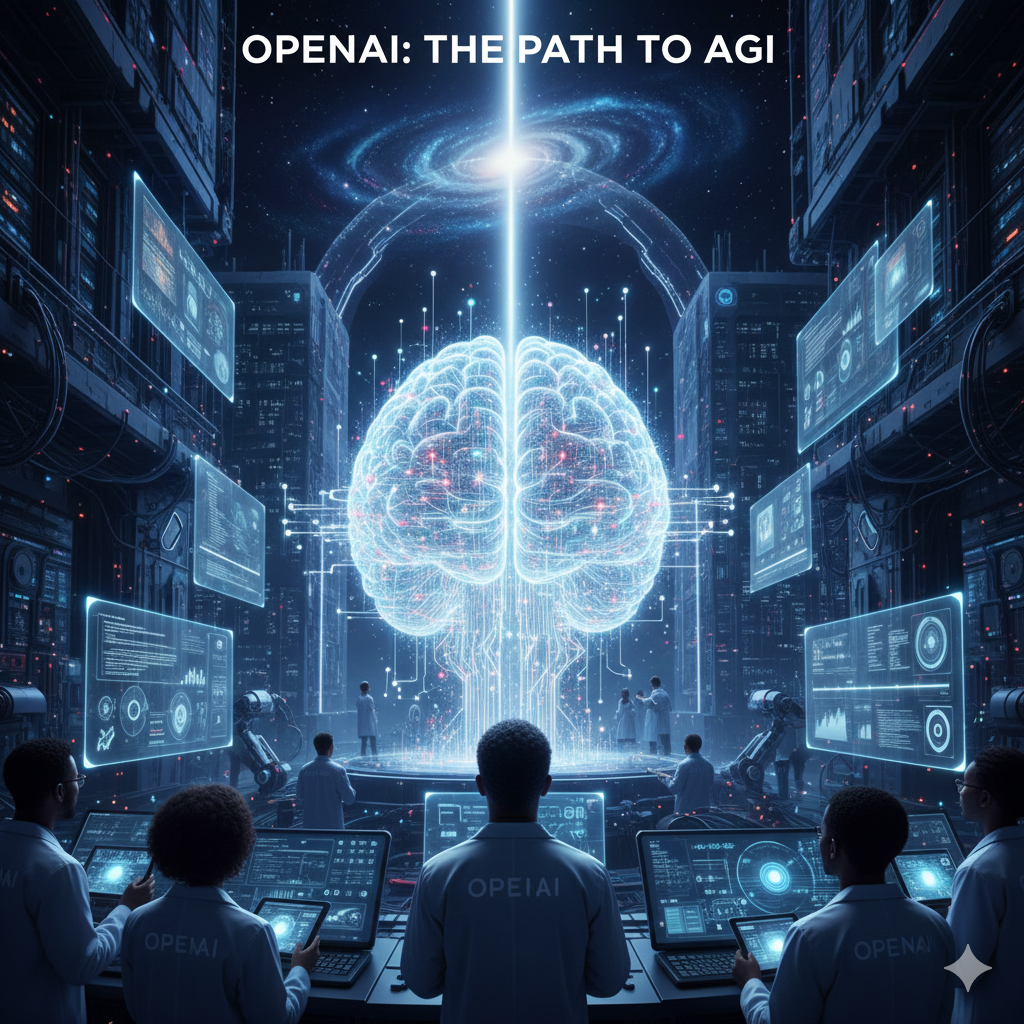
As we navigate through the technological landscape of 2026, one name remains at the epicenter of the global conversation: **OpenAI**. What started as a non-profit research lab has evolved into the most influential entity in the history of computing. Their mission is as ambitious as it is controversial: the creation of **Artificial General Intelligence (AGI)**. AGI represents a theoretical milestone where an AI system can understand, learn, and perform any intellectual task that a human being can do. In 2026, OpenAI is no longer just building chatbots; they are architecting the foundational “Brain” of the next civilization. The path to AGI is paved with revolutionary breakthroughs, ethical dilemmas, and a vision that could change the definition of “humanity” itself.
Defining AGI in the 2026 Era
In previous years, AI was specialized—good at chess, translation, or generating images. AGI is different; it is “General.” It possesses the ability to generalize knowledge across unrelated domains. In 2026, OpenAI’s latest models are demonstrating “Reasoning-First” capabilities, moving away from simple pattern matching toward true logic and problem-solving. AGI is not just about having all the information in the world; it is about knowing how to apply it in novel, unpredictable situations, much like a human scientist or engineer would.
The Shift from GPT to World Models
The journey from GPT-4 to the current frontier models of 2026 involved a fundamental shift in architecture. OpenAI has moved beyond “Next-Token Prediction” toward **World Models**. These systems don’t just predict the next word in a sentence; they simulate the underlying physical and logical laws of the world. This allows the AI to “visualize” consequences and perform internal simulations before taking an action, a key requirement for autonomous agency and AGI-level performance.
Compute, Data, and the Scaling Laws
The path to AGI has been governed by “Scaling Laws”—the observation that more data and more compute power lead to exponentially more intelligent models. In 2026, OpenAI is utilizing massive “Stargate” level supercomputing clusters, powered by next-generation NVIDIA chips and custom silicon. However, they have also solved the “Data Wall” problem by utilizing high-quality synthetic data and specialized reasoning-dense datasets, ensuring that the AI continues to learn even after consuming the entire public internet.
OpenAI’s Multi-Stage Strategy
OpenAI has laid out a clear roadmap for achieving AGI, categorized by levels of capability. In 2026, we have officially surpassed “Level 2: Reasoners” and are entering the era of “Level 3: Agents.” These agents don’t just talk; they act. They can manage entire corporate workflows, conduct scientific research, and write their own software to solve complex problems.
The Role of Agentic AI in the AGI Journey
Agentic AI is the bridge to AGI. By giving AI systems the ability to use tools—browsers, terminal consoles, and financial APIs—OpenAI is allowing the models to “experience” the world. This feedback loop between action and result is how the AI develops a deeper understanding of cause and effect, bringing it closer to the versatile intelligence of a human being.
Recursive Self-Improvement
A critical milestone on the path to AGI is the “Intelligence Explosion.” This occurs when an AI becomes capable enough to write and optimize its own code. In 2026, OpenAI is using AI to design the architectures of future AI models. This recursive loop is accelerating progress beyond human speed, making the jump from specialized agents to general intelligence a matter of months rather than decades.
The Safety Paradigm: Superalignment
As the capabilities of these systems approach AGI, the risk of “Misalignment”—where the AI’s goals don’t match human values—becomes a catastrophic threat. OpenAI’s **Superalignment Team** is tasked with building a “Human-Level Governer” within the AI. In 2026, they are using AI to supervise other AI, creating a hierarchy of safety that ensures the path to AGI remains under human control.
Global Governance and Ethical Guardrails
OpenAI has moved from a private company model toward a “Global Utility” framework. In 2026, they are working with international bodies to establish “AGI Treaties.” These treaties ensure that the benefits of AGI—such as curing diseases and solving climate change—are distributed equitably across the globe, preventing a “Digital Divide” that could destabilize the global economy.
Conclusion: The Final Frontier of Innovation
The path to AGI is the ultimate challenge for human ingenuity. Through OpenAI’s relentless pursuit of scale and reasoning, we are standing on the precipice of a new era. AGI will be the last invention humanity ever *needs* to make, as it will assist us in solving every other challenge we face. As we move forward into 2026 and beyond, the focus remains on the “Alignment” of this power—ensuring that as we build a mind that equals or surpasses our own, it remains our greatest ally. The journey is far from over, but the destination is in sight. Welcome to the dawn of General Intelligence.