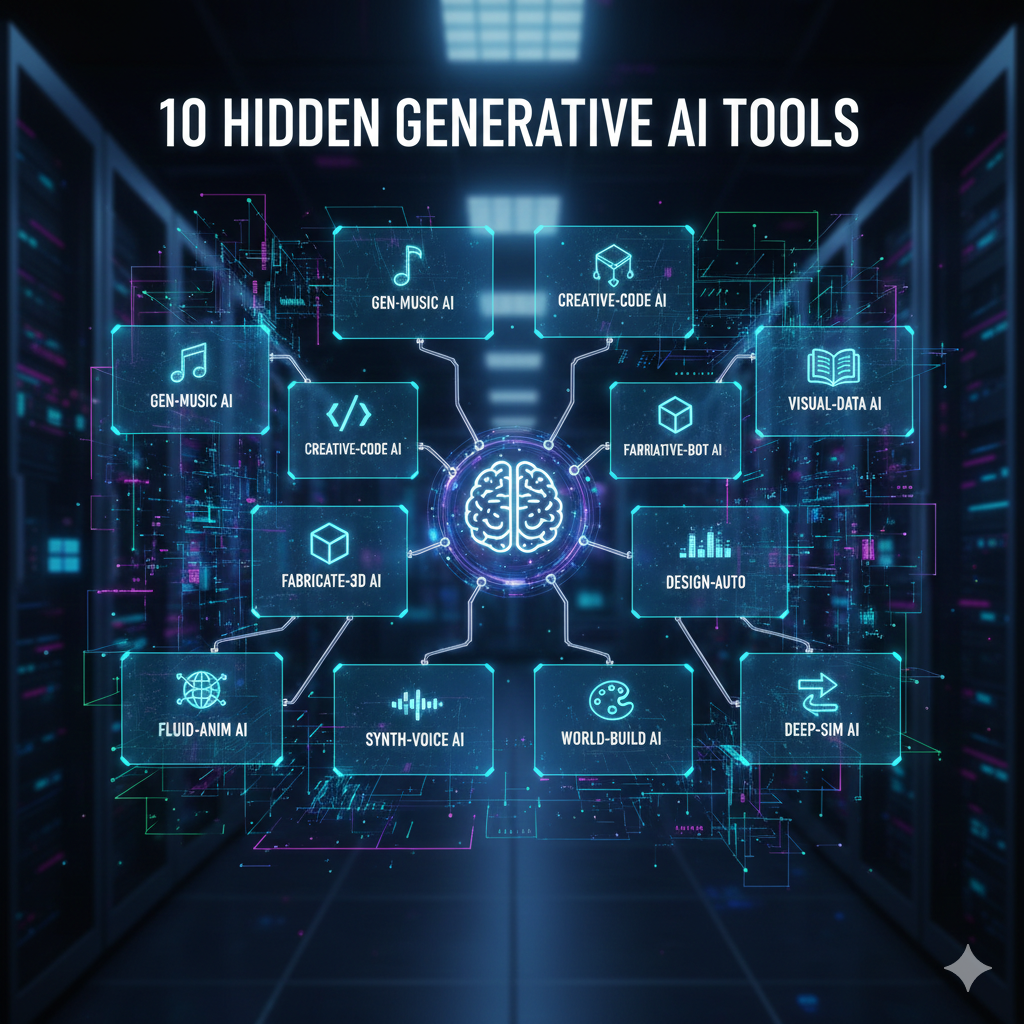
By early 2026, the world has moved far beyond the initial shock of ChatGPT. While Large Language Models (LLMs) like GPT-5 and Gemini 2.0 dominate the headlines, a silent revolution is taking place in the specialized niches of the AI ecosystem. Generative AI has evolved into a multi-modal powerhouse, offering tools that can generate everything from professional-grade cinema to complex biological structures and functional software architectures. For the digital creator, entrepreneur, and researcher, the real competitive edge lies not in the famous chatbots, but in the **Hidden AI Tools** that operate under the radar. These 10 tools are redefining what is possible, turning individual creators into full-scale production studios.
The Evolution of Niche Generative AI
The “Generalist” era of AI is being challenged by “Specialist” models. In 2026, we are seeing tools that are trained on highly specific datasets—legal documents, cinematic lighting, and genomic sequences. These hidden gems offer a level of precision that general-purpose models cannot match. They understand the nuances of a specific industry’s jargon, the physics of a specific environment, and the ethical constraints of a specific profession.
1. Neuro-Cinematic Editors: The Death of Post-Production
One of the most powerful hidden tools in 2026 is the Neuro-Cinematic Editor. Unlike traditional video editors, these tools use generative AI to re-light a scene after it has been filmed. You can change a sunny afternoon shot into a moonlit rainy night without any manual masking. These tools analyze the 3D geometry of the footage and regenerate the pixels to match the new lighting conditions, saving filmmakers millions in production costs.
AI-Native Soundscapes and Foley
Complementing the visual shift is the rise of AI tools that generate infinite, non-looping ambient soundscapes. In 2026, Foley artists are using generative audio to create the sound of a “dinosaur walking on wet glass”—a sound that doesn’t exist in nature—simply by describing it. This tool generates the audio at 192kHz, providing a level of sonic detail that is indistinguishable from reality.
Productivity and Research: The Hidden Powerhouses
In the professional world, the most valuable AI tools are those that handle the “cognitive grunt work.” In 2026, these hidden tools are managing complex data synthesis and strategic planning, allowing humans to focus on high-level creative vision.
2. Synthesized Research Agents
While ChatGPT can summarize a paper, 2026’s hidden research tools can synthesize 10,000 papers across different languages and identify a “knowledge gap.” These tools are used by pharmaceutical researchers to find potential drug interactions that human scientists might miss. They don’t just provide text; they provide a 3D mapped visualization of the current state of human knowledge in a specific field.
3. Generative CAD and Architectural Design
In 2026, architects are using hidden generative tools to “grow” buildings. Instead of drawing lines, they input constraints—wind speed, solar exposure, and material cost—and the AI generates 500 viable, hyper-efficient structural designs. These tools use evolutionary algorithms to ensure that the buildings are not only beautiful but also carbon-negative and structurally superior to anything designed by traditional methods.
4. Dynamic Code Architects
The era of “copilots” has evolved into “architects.” Hidden coding tools in 2026 can now generate entire back-end infrastructures from a single diagram. They manage the database schema, the API endpoints, and the security protocols autonomously. This allows a single developer to build and deploy complex, enterprise-level applications in a matter of days rather than months.
The Creative Frontier: Music and Fashion
Creativity is no longer bound by technical limitations. Generative tools in 2026 are allowing artists to experiment with forms and sounds that were previously physically impossible to create.
5. Multi-Track Generative Orchestras
In 2026, musicians are using hidden tools to generate “Liquid Music.” This is music that changes based on the listener’s heart rate or environment. The AI generates the stems (drums, bass, melody) in real-time, ensuring that every listening experience is unique. This is a far cry from the simple AI-generated lo-fi beats of the past; these tools are now being used by world-class composers to expand their sonic palettes.
6. Virtual Fabric and Fashion Synthesis
The fashion industry is being disrupted by tools that generate virtual fabrics with impossible physical properties. In 2026, designers for the metaverse and AR glasses use these tools to create clothes that shimmer like water or change texture based on digital “weather.” These generative fabrics are then used to create 3D assets that are perfectly optimized for spatial computing devices.
Conclusion: Navigating the AI Toolbox
The 10 hidden generative AI tools of 2026 represent the true democratization of expertise. We are entering an era where the only limit is the quality of the prompt and the depth of the imagination. As these tools continue to evolve, they will move from being “hidden” to being the standard operating system for all human creativity. By mastering these specialized niche tools, you are not just using AI; you are directing a digital symphony of potential. The future of AI is not a single giant; it is a thousand specialized geniuses, and they are all at your fingertips. Welcome to the era of infinite execution.