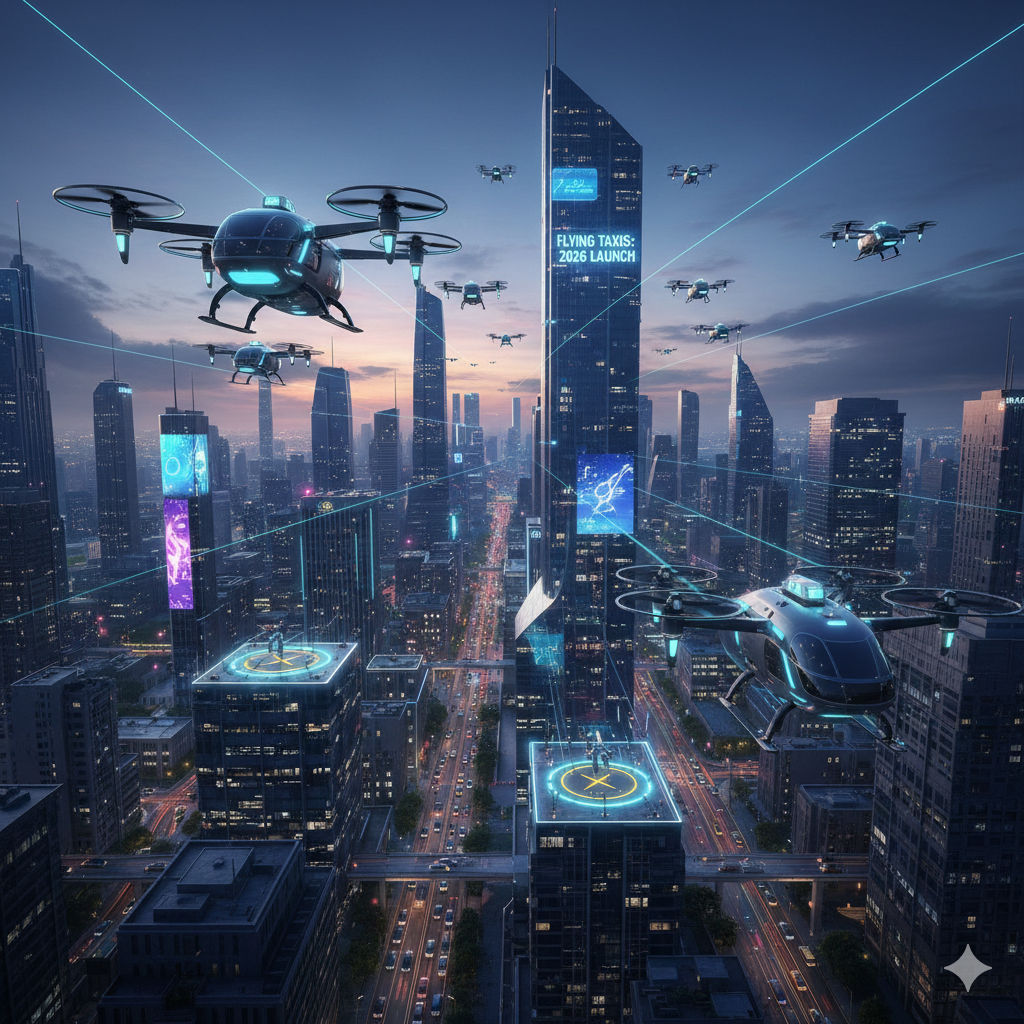
The year 2026 will be remembered as the moment the science fiction of the 20th century became the reality of the 21st. For decades, the “flying car” was a symbol of a distant future, but with the official global launch of **Flying Taxis** this year, that future has arrived. Powered by **eVTOL** (electric Vertical Take-Off and Landing) technology, these aircraft are not helicopters; they are a fundamentally new category of transportation. Quiet, emission-free, and increasingly autonomous, flying taxis are taking to the skies in major hubs like Dubai, Paris, and Los Angeles. In 2026, the sky is no longer just for long-distance travel; it is the new express lane for daily urban commuting.
The Technology: Beyond the Helicopter
The secret behind the 2026 launch is the maturation of Distributed Electric Propulsion (DEP). Unlike a helicopter with one large, noisy rotor, eVTOLs use multiple small electric motors spread across the wings or frame. This makes them significantly quieter—so quiet they can land in residential neighborhoods without disturbing the peace. In 2026, battery density has finally reached the level where these aircraft can carry 4-6 passengers for up to 100 miles on a single charge, making intra-city hops both viable and efficient.
Autonomous Flight and Digital Air Traffic Control
While the first wave of 2026 launches features human-supervised flight, the path to full autonomy is rapidly accelerating. 6G connectivity and AI-driven navigation allow flying taxis to communicate with each other in real-time, maintaining safe distances and optimizing flight paths. In 2026, the “Digital Sky” is managed by automated air traffic control systems that can handle thousands of aircraft simultaneously, far exceeding the capacity of traditional human-led systems.
Vertiports: The New Urban Hubs
The 2026 launch is not just about the planes; it is about the infrastructure. Cities are now integrating **Vertiports**—specialized landing pads located on the rooftops of parking garages, train stations, and office buildings. These hubs are equipped with ultra-fast charging stations that can replenish an eVTOL’s battery in the time it takes for passengers to board and disembark. Vertiports are becoming the new town squares of the 2026 urban landscape, seamlessly connecting air travel with ground-based electric transit.
The Economic Shift: From Luxury to Utility
One of the biggest surprises of the 2026 launch is the cost. While initial predictions suggested flying taxis would be for the ultra-wealthy, the high efficiency of electric motors and the shared-ride model have brought prices down. In 2026, a flight across a congested city costs roughly the same as a premium ground-based ride-share service. This price parity is driving mass adoption, as people realize that a 60-minute traffic jam can be replaced by a 10-minute aerial glide.
The Impact on Real Estate and Urban Planning
Flying taxis are fundamentally changing where people choose to live. In 2026, “commutable” distances have expanded from 20 miles to 80 miles. This is leading to a revitalisation of rural and semi-rural areas, as people can live in quiet, natural environments and “fly-in” to the city center for work in less time than it takes to drive from the suburbs. Cities are also reclaiming space; as demand for ground roads decreases, urban planners are turning former highways into parks and pedestrian zones.
Environmental Benefits: The Clean Sky Initiative
The 2026 launch is a cornerstone of global net-zero goals. Because eVTOLs are 100% electric, they produce zero operational emissions. In 2026, the aviation industry’s carbon footprint is shrinking for the first time in history, as short-haul urban flights transition away from fossil fuels. This “Clean Sky” initiative is making cities more breathable and less noisy, improving the overall quality of life for millions of urban dwellers.
Challenges and Regulatory Milestones
The journey to the 2026 launch was not without hurdles. Safety remains the number one priority. In 2026, all flying taxis are equipped with redundant systems—multiple motors, backup batteries, and even ballistic parachutes for the entire aircraft. Regulatory bodies like the FAA and EASA have created a new category of pilot certification specifically for eVTOLs, ensuring that the highest safety standards are maintained as the industry scales.
Public Acceptance and Noise Mitigation
In 2026, social acceptance is high, largely due to the focus on noise reduction. Manufacturers have developed specialized propeller designs that blend into the city’s background noise. Public demonstrations throughout 2025 were key to showing citizens that flying taxis are not a nuisance but a valuable public utility. As a result, the “NIMBY” (Not In My Backyard) sentiment has largely been replaced by a desire for Vertiport access.
Conclusion: The Sky is No Longer the Limit
The 2026 launch of flying taxis is the beginning of a new chapter in human history. We have finally unchained ourselves from the limitations of the ground. As we look forward to the rest of the decade, the integration of airborne mobility will continue to accelerate, making our cities more connected, our commutes more enjoyable, and our planet more sustainable. We are the first generation to witness the true democratization of the skies. In 2026, the future isn’t just coming; it is already hovering above us. Welcome to the era of airborne mobility.