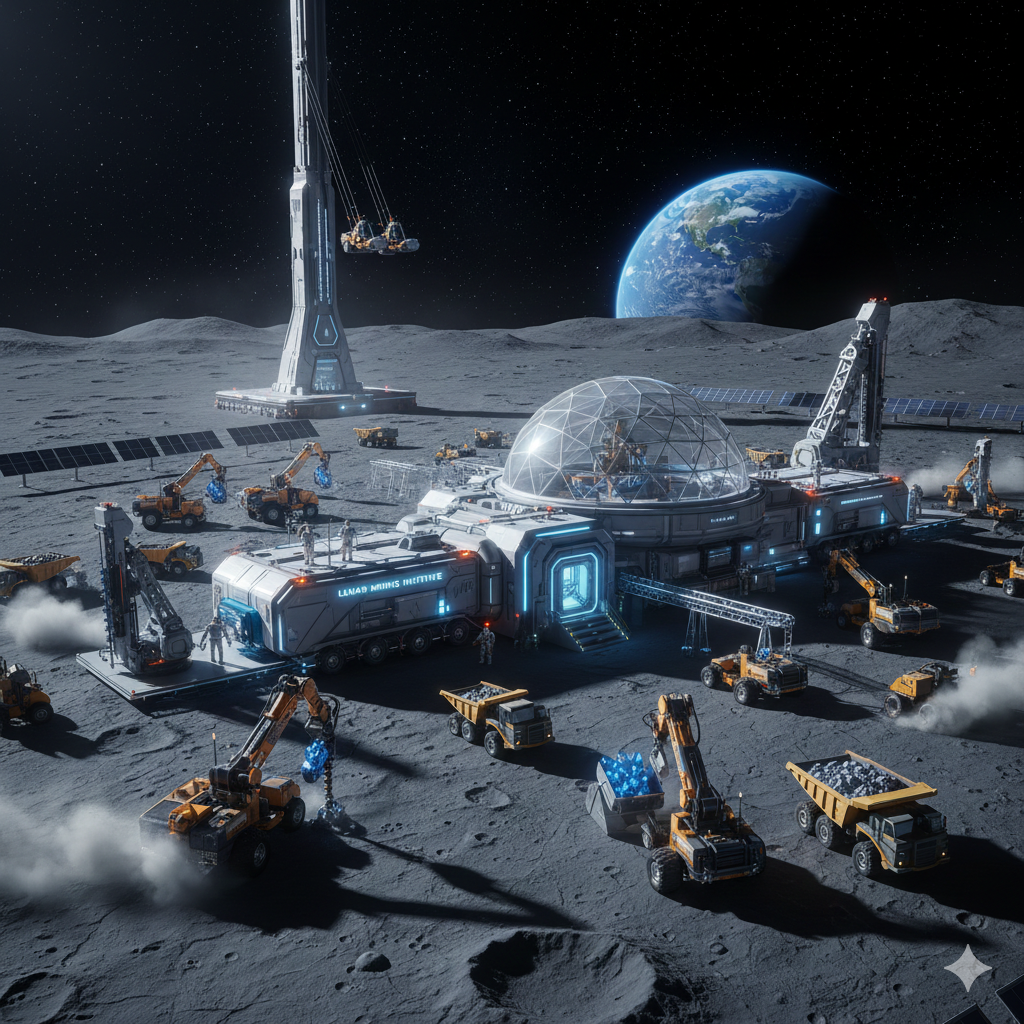
The year 2026 has officially inaugurated the era of the space economy. No longer is the Moon just a celestial body for observation and footprints; it has become the most valuable real estate in the solar system. **Mining Minerals on the Moon** is the primary driver of the new space gold rush, as nations and private corporations race to secure resources that are scarce on Earth but abundant on the lunar surface. From the energy-rich Helium-3 to the life-sustaining water ice at the lunar poles, the Moon is being transformed into a vital resource hub that will power human civilization on Earth and enable the further colonization of Mars.
The Strategic Value of Lunar Minerals
The Moon is a treasure trove of raw materials that are critical for 21st-century technology. Unlike Earth, which has a protective atmosphere and geologic activity that hides minerals, the Moon has been bombarded by solar winds and asteroids for billions of years, depositing rare elements directly onto its surface (the regolith). In 2026, we have moved beyond mapping to active extraction, using autonomous robotic swarms to harvest these materials.
Helium-3: The Holy Grail of Clean Energy
Perhaps the most significant mineral on the Moon is **Helium-3**. This rare isotope is extremely scarce on Earth but is found in vast quantities in the lunar regolith, deposited by solar winds over eons. Helium-3 is the key to safe, clean, and efficient nuclear fusion power. In 2026, calculations suggest that just 25 tons of Helium-3—roughly one Starship cargo load—could power the entire United States for a year. This potential for “Infinite Energy” is the primary reason for the geopolitical intensity surrounding lunar mining rights.
Rare Earth Metals and Manufacturing
The Moon contains high concentrations of rare earth metals, including Neodymium and Yttrium, which are essential for electronics, electric vehicle motors, and advanced weaponry. As Earth’s supply chains become increasingly strained and politically complex, lunar mining provides a sovereign alternative. In 2026, the first “Lunar-to-Earth” shipments of refined rare earth metals have proven that space-based manufacturing is no longer a theoretical exercise but a commercial reality.
Water Ice: The ‘Oil’ of the Solar System
In 2026, the most precious resource on the Moon is not gold or Helium-3—it is **Water Ice**. Located in the permanently shadowed craters of the lunar South Pole, this ice is the lifeblood of the space economy. Water is essential for life support, but more importantly, it can be broken down into Hydrogen and Oxygen to create rocket fuel.
Lunar Refueling Stations
Launching fuel from Earth is incredibly expensive due to our planet’s deep gravity well. By mining water ice on the Moon and converting it into fuel, we are creating “Gas Stations in Space.” In 2026, Starships and other heavy-lift vehicles are using the Moon as a pit stop. Refueling in lunar orbit allows spacecraft to depart for Mars or the outer planets with their cargo bays full, effectively turning the Moon into the gateway to the solar system.
Regolith as a Building Material
Lunar soil, or regolith, is rich in silicon, iron, and aluminum. In 2026, we are not just mining it to send back to Earth; we are using it to build the Moon bases of the future. Autonomous 3D-printing robots are sintering regolith to create landing pads, habitat shields, and underground tunnels. This “In-Situ Resource Utilization” (ISRU) is making the lunar colony self-sufficient and reducing the cost of expansion by over 90%.
Technological Breakthroughs in 2026
Mining in a vacuum with 1/6th of Earth’s gravity presents unique challenges. The 2026 lunar mining fleet consists of highly specialized autonomous agents designed to operate in the harsh lunar environment without constant human intervention.
1. Autonomous Robotic Swarms
Instead of one large excavator, 2026 mining operations utilize hundreds of small, interconnected robots. These swarms work together like ants, mapping the soil, filtering for specific isotopes, and transporting the refined material to centralized launch platforms. This “swarm intelligence” ensures that if one robot fails, the operation continues, making lunar mining highly resilient and cost-effective.
2. Solar Thermal Sintering
Electricity is a premium resource on the Moon. In 2026, mining operations are using massive parabolic mirrors to focus sunlight into high-intensity beams. This heat is used to “sinter” or melt the lunar soil, extracting minerals and gases without the need for traditional combustion-based refining processes. This “Green Mining” approach is essential for maintaining the pristine environment of the lunar surface.
Geopolitics and the Artemis Accords
As of 2026, the “Artemis Accords” serve as the legal framework for lunar mining, ensuring that no single nation can claim the Moon as their own, while allowing for the extraction of resources in specific “Safety Zones.” However, tensions remain between the leading space agencies and private corporations over the most resource-dense craters. Your website’s focus on these legal and ethical frontiers is vital for providing the authoritative content that global readers seek.
Conclusion: The Foundation of a Galactic Economy
Mining minerals on the Moon is the first step toward becoming a true spacefaring civilization. By harvesting the energy and materials of our nearest neighbor, we are solving the resource crisis on Earth and fueling the exploration of the stars. In 2026, the Moon is no longer a distant light in the sky; it is an industrial engine, a scientific laboratory, and a springboard for humanity’s greatest adventure. The gold rush of the 21st century is in full swing, and it is happening 238,000 miles above our heads. Welcome to the era of the lunar economy.