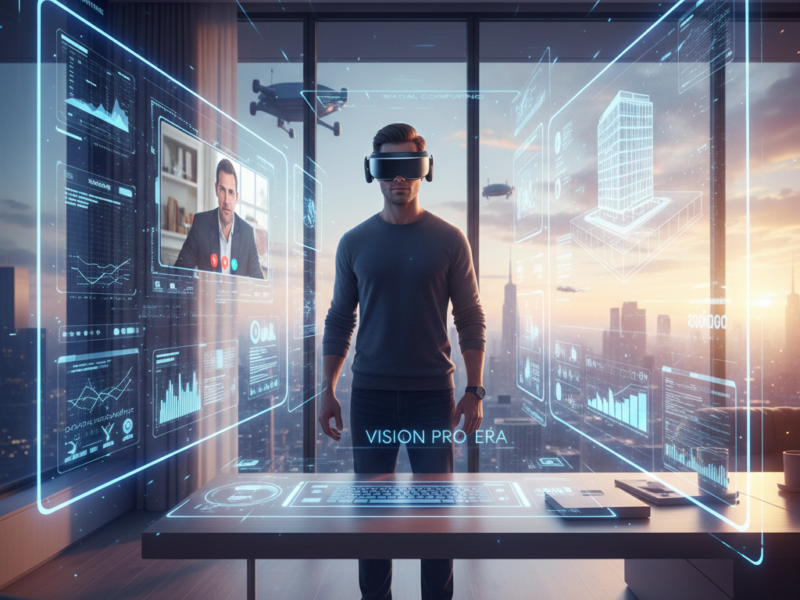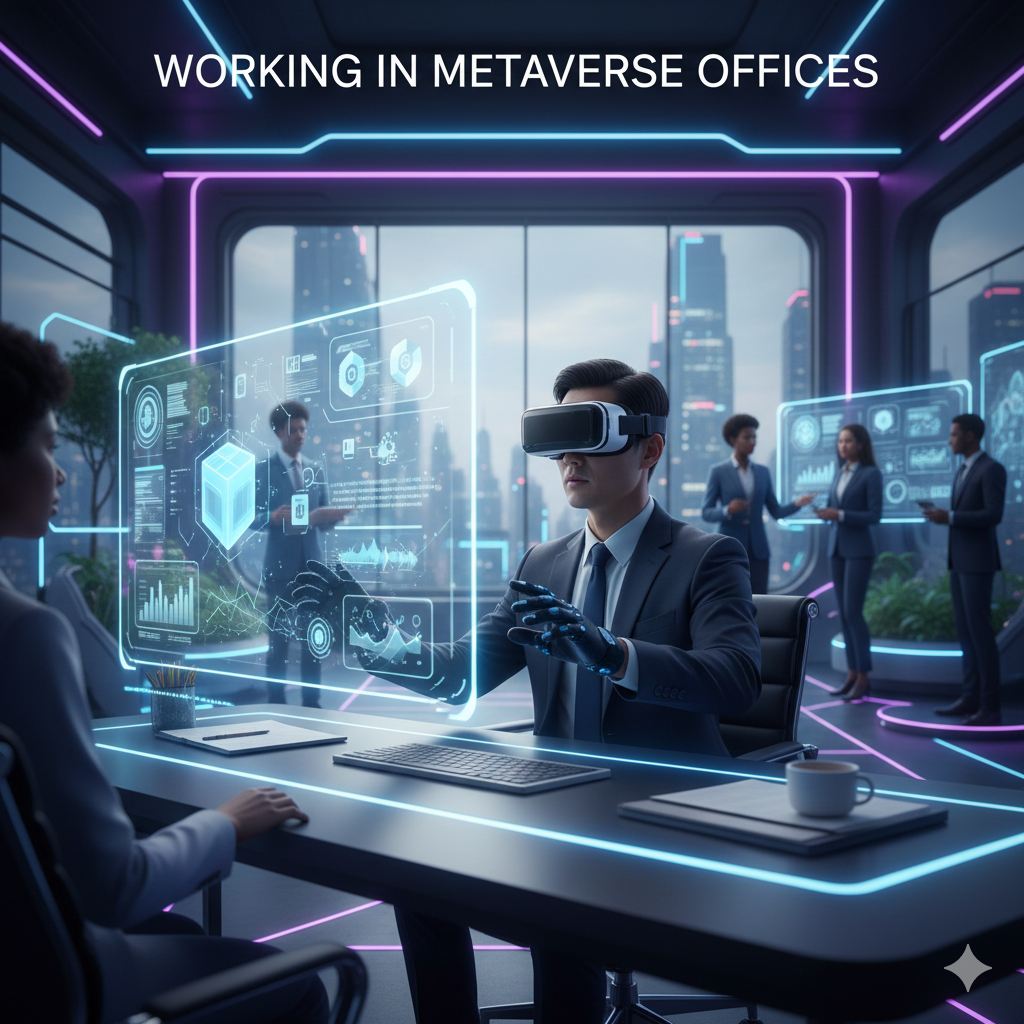
The year 2026 has witnessed the final death of the 2D video call. While the early 2020s were defined by the flat, exhausting experience of “Zoom fatigue,” the current era is defined by presence. **Working in Metaverse Offices** has transitioned from a niche experiment to a standard corporate practice for global teams. In 2026, the office is no longer a physical destination you commute to; it is a persistent, immersive 3D environment that you “enter” using spatial computing. These virtual workspaces have solved the isolation of remote work by providing a shared sense of space, allowing colleagues to collaborate, innovate, and socialize as if they were physically standing in the same room. The Metaverse office is the ultimate realization of a borderless, high-productivity workforce.
The Anatomy of a 2026 Metaverse Office
Unlike the cartoonish environments of the past, 2026 Metaverse offices are high-fidelity “Digital Twins” of high-end architectural spaces. Companies are investing in bespoke virtual campuses that reflect their brand and culture. When you put on your light-weight AR glasses or VR headset, you are transported into a workspace where light filters through digital windows, and the acoustics mimic a real office environment. This spatial immersion is what makes the virtual office feel like a “place” rather than an “app.”
1. Photorealistic Avatars and Non-Verbal Communication
In 2026, we have moved past legless avatars. Current technology utilizes high-fidelity “Codec Avatars” that use face-tracking sensors to mirror your real-time expressions, eye movements, and body language. This level of detail is crucial for professional trust; in the Metaverse office, you can see a colleague’s subtle nod, their furrowed brow during a brainstorming session, or a genuine smile. This restoration of non-verbal cues has dramatically increased the effectiveness of remote leadership and team bonding.
Spatial Audio: The Sound of Presence
The most underrated feature of the 2026 Metaverse office is **Spatial Audio**. In a traditional video call, everyone’s voice comes from the same direction. In the Metaverse, sound is localized. If a colleague is standing to your left, their voice comes from the left. As you walk away from a group, their conversation naturally fades. This allows for “Spontaneous Collisions”—the ability to pull someone aside for a quick chat or join a group discussion organically, just as you would in a physical hallway.
Tools of the Trade: Collaboration in 3D
Working in the Metaverse in 2026 is inherently more productive for certain tasks because it utilizes the “Third Dimension.” We are no longer limited by the size of a laptop screen; our entire field of vision is our desktop.
2. The Infinite Whiteboard and 3D Prototyping
Imagine a whiteboard that never ends. In a Metaverse meeting, teams can stand around 3D models of a new product, walk inside a digital architectural plan, or visualize complex data as a glowing constellation of information. Engineers in 2026 use haptic gloves to “touch” and manipulate virtual prototypes, identifying design flaws in the Metaverse before a single physical unit is manufactured. This hands-on collaboration is the primary reason why tech and manufacturing giants have fully migrated to virtual campuses.
3. Deep Focus Zones and AI-Integration
Metaverse offices are not just for meetings; they are designed for “Deep Work.” In 2026, employees can customize their personal virtual workstations to eliminate distractions. You could be working in a virtual library or on a quiet digital beach, with your AI assistant filtering notifications and projecting your tasks onto floating holographic screens. The office environment now adapts to the psychological needs of the worker, rather than the worker adapting to the office.
The Economic and Social Impact
The widespread adoption of Metaverse offices in 2026 is reshaping the global economy. Companies are saving billions on real estate and energy costs, while employees are saving thousands of hours previously lost to commuting. This is the era of the “Global Talent Pool,” where a developer in Karachi, a designer in Milan, and a manager in New York can work together in the same virtual room with zero latency.
Conclusion: The End of the Commute
Working in Metaverse offices is the final step in the evolution of work. It has successfully merged the flexibility of remote work with the social and collaborative power of the physical office. As we move forward into 2026 and beyond, the office will continue to be a destination—not of bricks and mortar, but of light and logic. We have finally unchained the workplace from the ground, allowing humanity to build, create, and connect in a world of infinite possibilities. Welcome to the office of the future.