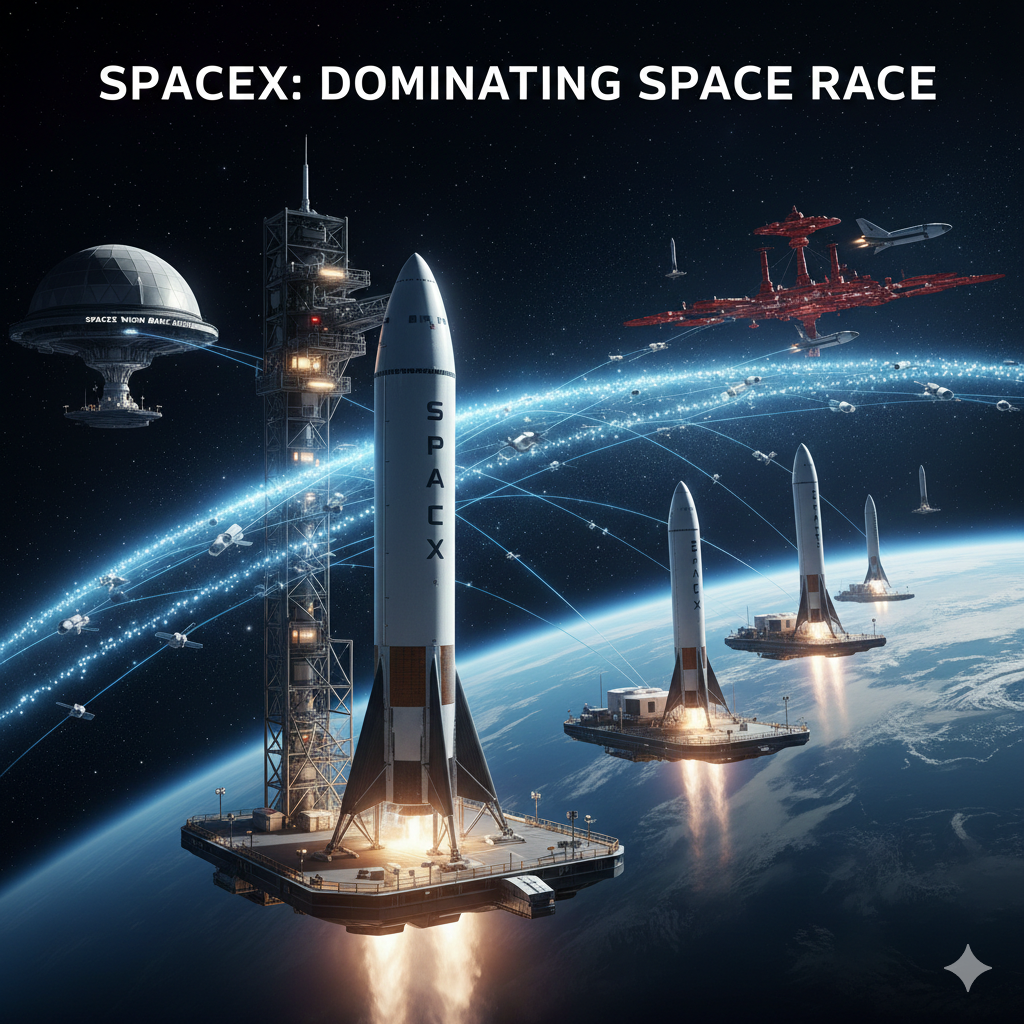

By early 2026, the global space race is no longer a contest of nations, but a testament to the relentless innovation of a single private entity: **SpaceX**. Under the audacious vision of Elon Musk, SpaceX has not merely participated in the space industry; it has redefined it, utterly dominating every facet from satellite deployment to deep-space exploration. Reusable rockets, mass-produced satellites, and the colossal Starship system have turned science fiction into daily headlines. In 2026, SpaceX is not just launching payloads; it is laying the foundational infrastructure for humanity’s multi-planetary future, making space travel and communication more accessible and affordable than any time in history. The company’s achievements are so profound that other space agencies are now benchmarked against “the SpaceX standard,” solidifying its position as the undisputed leader of the cosmos.
The Reusability Revolution: Falcon 9 and Heavy
The cornerstone of SpaceX’s dominance in 2026 remains its revolutionary reusability. The Falcon 9 and Falcon Heavy rockets, which were once considered engineering marvels, are now workhorses that routinely launch, land, and relaunch within days. This rapid turnaround has slashed launch costs by over 90% compared to traditional single-use rockets, creating an economic advantage that no competitor can match. In 2026, it’s not uncommon to see a single Falcon 9 booster having completed over 20 orbital missions, proving the unparalleled reliability and cost-effectiveness of SpaceX’s designs.
1. The Starlink Megaconstellation: Global Internet for All
In 2026, **Starlink** is not just a high-speed internet service; it is a global utility. With over 12,000 active satellites in Low Earth Orbit (LEO), Starlink provides reliable, low-latency internet access to nearly every corner of the planet. From remote villages in the Amazon to disaster zones cut off from traditional infrastructure, Starlink ensures connectivity. This sprawling network, built and maintained by SpaceX, has not only transformed global communication but also generates a significant revenue stream, funding the company’s more ambitious deep-space projects.
Accelerated Deployment with Starship
The deployment rate of Starlink satellites has dramatically increased in 2026, thanks to Starship. Each Starship launch can carry hundreds of Starlink satellites, deploying them with unprecedented efficiency. This capability has allowed SpaceX to expand its constellation far more rapidly than any other satellite provider, further solidifying its monopoly on LEO internet services.
Starship: The Interplanetary Game Changer
The crown jewel of SpaceX’s 2026 arsenal is **Starship**—a fully reusable, super heavy-lift launch system designed to transport both cargo and humans to the Moon, Mars, and beyond. In 2026, Starship has achieved multiple successful orbital flights, demonstrating its ability to land and relaunch. Its immense payload capacity (over 100 tons to LEO) and rapid reusability are completely changing the economics of space exploration, making Moon bases and Martian cities viable within the decade.
2. Moon and Mars Missions: Paving the Way for Humanity
In 2026, Starship is the primary vehicle for NASA’s Artemis program, ferrying astronauts to the lunar surface for the first time in over 50 years. Beyond the Moon, SpaceX has initiated its initial cargo missions to Mars, sending supplies and robotic probes in preparation for human landings. These Mars cargo missions are critical for scouting resources, setting up communication relays, and establishing rudimentary infrastructure that will eventually support a self-sustaining Martian colony. The “Mars Base Alpha” is no longer a distant dream but a planned engineering project.
3. Point-to-Point Earth Travel: Suborbital Transport
While still in its early stages of regulatory approval in 2026, SpaceX is actively demonstrating Starship’s capability for **point-to-point suborbital travel on Earth**. Imagine flying from New York to Shanghai in under an hour. This ambitious project promises to revolutionize long-haul transportation, making transcontinental travel faster than ever before. Although passenger flights are a few years away, the potential impact on logistics and rapid response capabilities is immense.
Global Impact and Competitive Landscape
SpaceX’s unparalleled success has forced traditional aerospace giants and national space agencies to adapt or risk obsolescence. In 2026, every major player in the space industry is either attempting to replicate SpaceX’s reusability model or partnering with the company for launch services. The dominance of SpaceX has accelerated the entire industry, pushing the boundaries of what is possible and inspiring a new generation of space engineers and entrepreneurs.
Conclusion: The Architect of Tomorrow’s Universe
SpaceX is not just a company; it is a movement. In 2026, its relentless drive for innovation, cost reduction, and audacious goals has firmly placed it at the helm of the global space race. From connecting the unconnected with Starlink to making humanity a multi-planetary species with Starship, SpaceX is actively building the infrastructure for tomorrow’s universe. The future of space is no longer a government-led endeavor; it is being shaped by the vision and ingenuity of a private company that dared to dream beyond Earth’s gravity. Welcome to the SpaceX era, where the stars are no longer the limit, but merely the next destination.