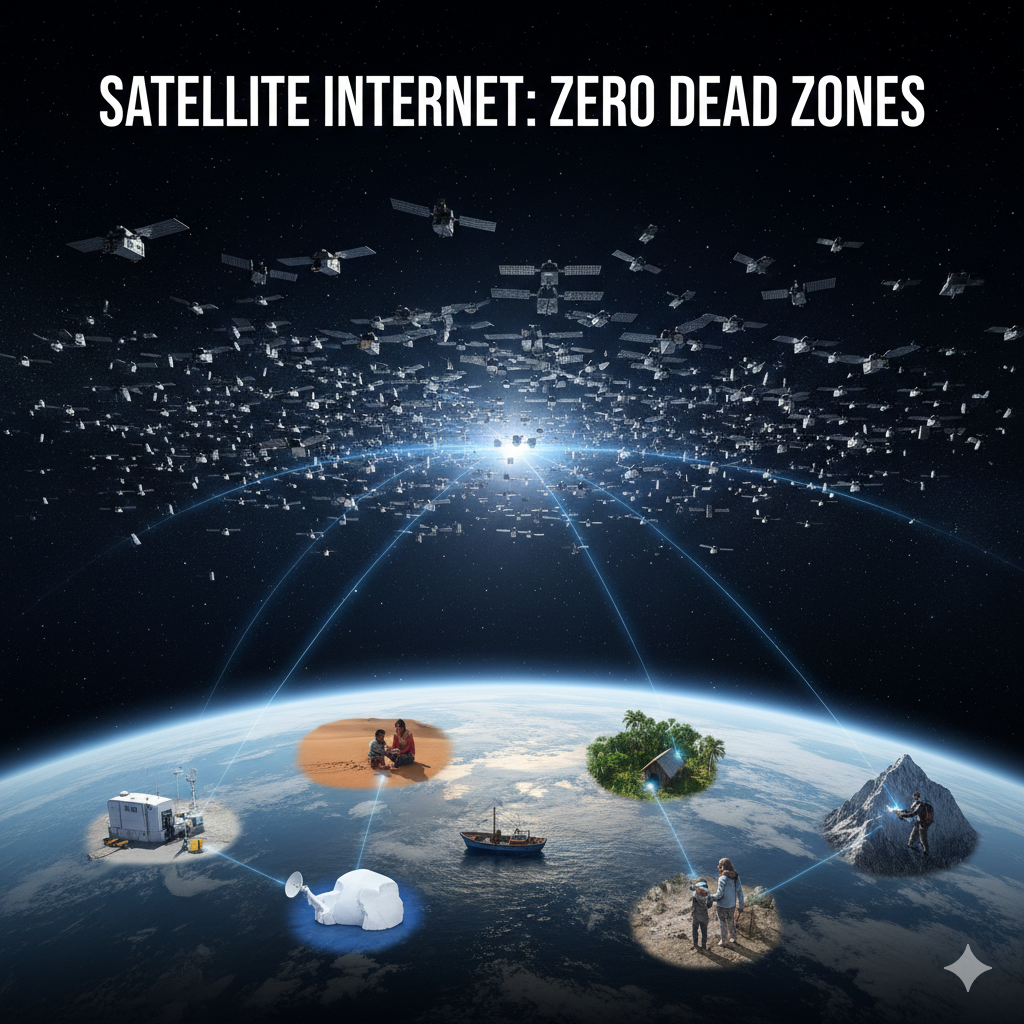

By early 2026, the concept of an “internet dead zone” has largely become a relic of the past. Thanks to the rapid deployment of massive Low Earth Orbit (LEO) satellite constellations, high-speed, low-latency internet access is now available virtually anywhere on Earth, regardless of geographical barriers. **Satellite Internet: Zero Dead Zones** is no longer a futuristic dream but a present-day reality, transforming remote communities, enhancing global commerce, and fundamentally reshaping how humanity connects. Companies like Starlink, Project Kuiper, and OneWeb have launched tens of thousands of satellites, creating a robust, interconnected web in the sky that promises to bridge the digital divide once and for all.
The LEO Revolution: Speed and Low Latency
Traditional satellite internet, based on geostationary (GEO) satellites, suffered from high latency due to their immense distance from Earth. In 2026, the game has completely changed. LEO satellites orbit at a mere 500-1,200 km, dramatically reducing latency to levels comparable with fiber optics. This technological leap means that satellite internet is now viable for real-time applications like online gaming, video conferencing, and cloud computing, which were impossible with older generations.
The Future of Universal Access
The elimination of dead zones by 2026 has profound implications across all sectors. Remote work, already a global trend, has accelerated further as professionals can truly work from any location—be it the middle of the Sahara or the depths of the Amazon. Education in underserved regions is being revolutionized by access to online learning platforms, and e-commerce is now booming in previously isolated communities, creating a truly globalized digital economy.
As we move forward, the challenge shifts from providing access to ensuring its sustainability and security. But one thing is certain: in 2026, the entire planet is finally, and permanently, online.