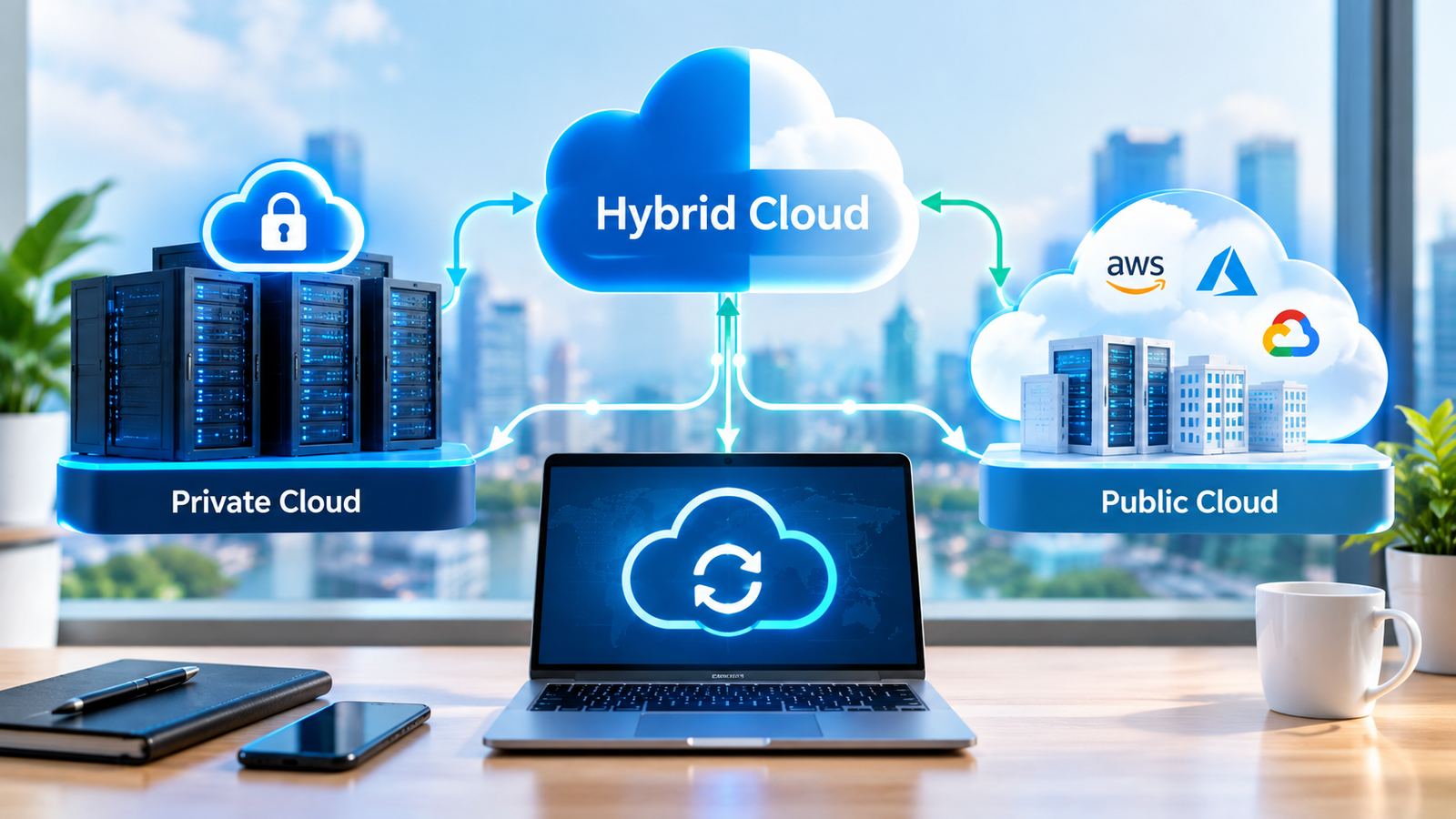
How Hybrid Cloud Systems Work Efficiently: The Architectural Blueprint
For years, hybrid cloud infrastructure was treated as a temporary compromise—a stepping stone on the way to full public cloud adoption. In 2026, that narrative has completely dissolved. Modern hybrid cloud computing is an intentional, permanent operating model chosen by over 75% of global enterprises to balance data sovereignty, maximize compute performance, and control spiraling infrastructure costs.
The Reality of Data Gravity and Workload Placement
The foundational secret to hybrid cloud efficiency relies on a concept known as data gravity. Moving massive datasets back and forth across different network environments is slow, creates high latency, and triggers expensive public cloud data egress (transfer) fees.
Instead of moving data to where the compute power lives, efficient hybrid architectures flip the script: they bring the compute to the data. By dynamically matching applications with the specific environment that suits them best, organizations avoid over-provisioning hardware and eliminate unnecessary data movement.
The Core Mechanics of Hybrid Efficiency
An efficient hybrid cloud system does not rely on manual scripts or brittle, custom-coded connections. Instead, it functions as a single, unified ecosystem driven by four technical core layers:
1. Containerization and Universal Abstraction
To move applications smoothly between private data centers and public platforms like AWS or Azure, workloads must be fully decoupled from the underlying hardware. By packaging software into containerized microservices (using Kubernetes or OpenShift), code runs identically whether it is hosted on an old on-premises bare-metal server or a cutting-edge cloud cluster.
2. Intelligent AI-Driven Orchestration
Orchestration serves as the automated traffic control center of the entire network. Modern systems integrate AI orchestration agents that continuously monitor capacity, application performance, and active billing rates. If an on-premises system experiences a sudden spike in user traffic, the orchestration engine automatically clones the necessary container applications and bursts them out into public cloud space—a mechanism called cloud bursting.
3. SD-WAN and Secure Edge Interconnects
Data transfer speeds are fundamentally restricted by physical distance and pipeline throughput. Efficient hybrid clouds use Software-Defined Wide Area Networks (SD-WAN) alongside encrypted dedicated connections. These pipelines establish intelligent data routing, prioritize mission-critical data packets over routine traffic, and safely compress transfers to maximize local network speed.
4. Unified Security Boundaries and Centralized FinOps
Operating in a hybrid setup can easily lead to fragmented security tracking and unpredictable billing. High-performing systems solve this via unified identity planes (like OpenTelemetry and Zero-Trust networking) and centralized FinOps dashboards. This provides IT management with complete visual oversight, tracking exact resource consumption and compliance profiles across all environments simultaneously.
Workload Mapping: Choosing the Optimal Environment
True architectural efficiency comes down to dividing enterprise applications by their specific computational profiles:
| Workload Profile | Best Deployment Zone | Efficiency Reason |
|---|---|---|
| Highly Regulated & Core Data | Private On-Prem / Sovereign Cloud | Guarantees full legal data control and prevents recurring network storage data egress costs. |
| Unpredictable or Seasonal Apps | Public Cloud Partition | Leverages massive elastic scale on demand, avoiding buying expensive on-site backup hardware. |
| High-Speed AI Inference & Manufacturing | Edge Cloud Computing Node | Processes analytical computations closer to sensors, drastically reducing data loop latency. |
- The AI Training and Production Split: Enterprises increasingly keep massive foundational datasets locally for security and privacy, while utilizing the vast GPU clusters of the public cloud solely for heavy model training and testing runs.
- Predictable Steady-State Baselining: Running regular, constant daily business logic on private infrastructure provides lower, predictable operational costs over multi-year cycles compared to fluctuating pay-per-hour cloud pricing.
- Automated Failover Protocols: High-efficiency setups use real-time synchronization loops; if a physical local data node undergoes an unexpected hardware crash, traffic routes immediately to backup cloud snapshots without interrupting user workflows.
“Maximizing hybrid cloud value requires moving past an ‘all-or-nothing’ infrastructure mentality. Efficiency is achieved when an enterprise builds a single operating model that treats data location as a strategic, cost-controlled variable.”
Long-Term Infrastructure Sustainability
As data scales and cloud architectures become increasingly complex, optimizing resource placement is no longer just an administrative choice—it is a critical requirement for long-term growth. Organizations that map out a cohesive hybrid infrastructure eliminate structural silos, lower energy footprints, and secure a flexible system capable of implementing future technological shifts without requiring a complete architectural rebuild.
Disclaimer: The structural summaries, engineering breakdowns, and architectural trends presented in this article are compiled strictly for educational, technical reference, and academic research purposes. Gartner, Kubernetes, AWS, Azure, OpenShift, and all associated software platforms or optimization frameworks are registered trademarks of their respective legal corporate owners. For specific network configurations or enterprise cloud audits, engage a certified infrastructure solutions architect.