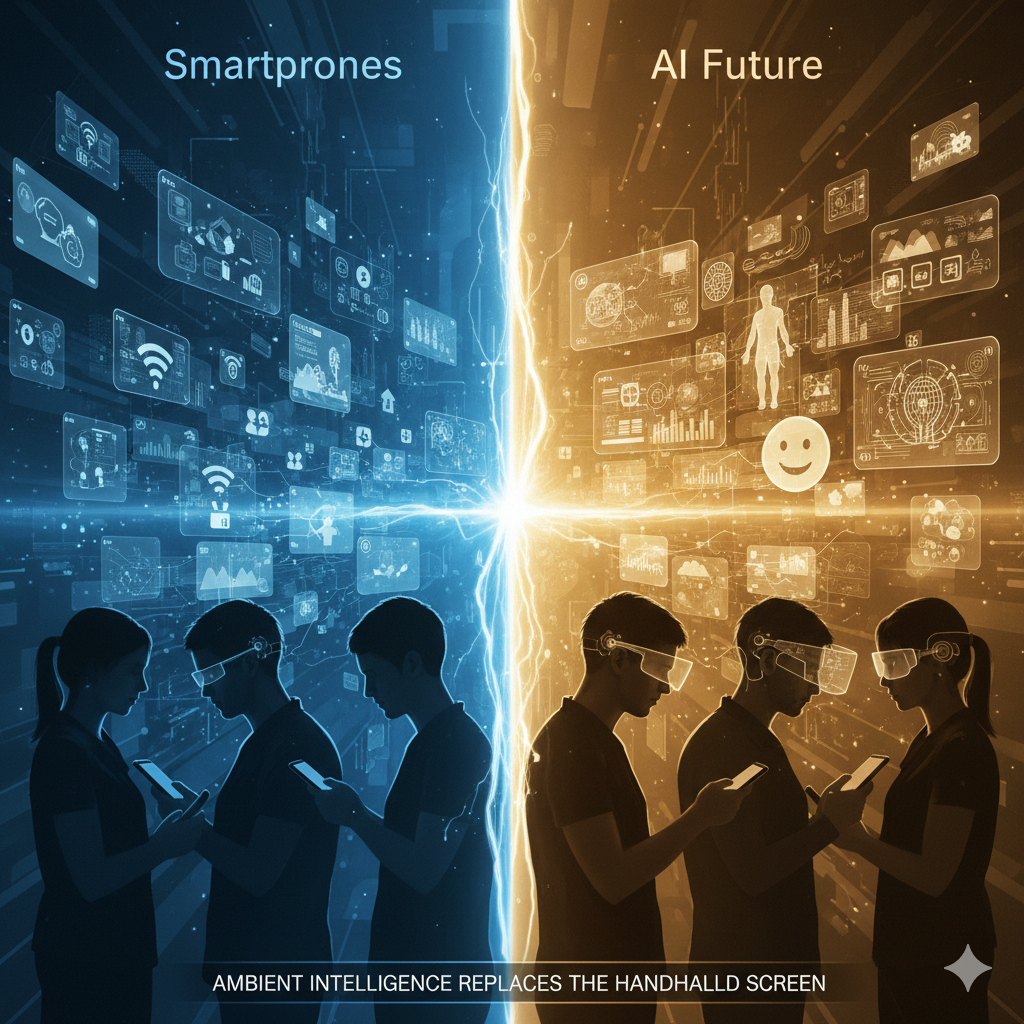

By early 2026, the tech world is witnessing the beginning of a historic showdown: **AI vs. Smartphones**. For nearly two decades, the smartphone has been the undisputed center of the human digital experience. However, the rapid advancement of Artificial Intelligence and wearable hardware has sparked a new revolution. We are moving away from “App-centric” living toward “Agent-centric” living. In 2026, the question is no longer which phone has the best camera, but whether you need a screen at all to interact with your digital life. With the rise of AI pins, smart glasses, and ambient computing, the smartphone’s dominance is being challenged by devices that promise to keep our heads up and our eyes on the real world, while AI handles the complexity of the virtual one in the background.
The App Era vs. The Agent Era
The smartphone’s power came from its apps. In 2026, however, “Apps” are becoming secondary to “Agents.” In the old model, if you wanted to book a flight, you opened a specific app, navigated menus, and manually entered data. In the 2026 AI-first world, your AI agent—living in a wearable device—does this for you via voice or a subtle gesture. It knows your preferences, your calendar, and your budget. This shift from manual navigation to intent-based interaction is the primary threat to the smartphone. When AI can perform tasks across different platforms seamlessly, the need for a central, screen-heavy slab of glass begins to diminish.
1. AI Hardware: The Rise of Wearables
In 2026, a new generation of hardware is hitting the mainstream. AI-powered smart glasses with holographic overlays and “AI Pins” that clip onto clothing are providing a more natural way to stay connected. These devices use multimodal AI—they see what you see and hear what you hear. If you are at a grocery store, your smart glasses can highlight healthy options on the shelf or remind you that you are out of milk at home. This “Contextual Intelligence” is something a smartphone in your pocket simply cannot provide with the same level of friction-less ease.
Ambient Computing: The Invisible Network
The concept of **Ambient Computing** is taking over in 2026. This means technology is built into the environment around us—in our cars, our office walls, and our home appliances. When the environment itself is “smart” and can respond to your voice or presence, the smartphone loses its role as the primary interface. In 2026, your digital identity follows you from one ambient device to another, making the physical phone feel like an unnecessary weight in your pocket. We are entering the age of “Invisible Tech,” where the most powerful tools are the ones you don’t even see.
Why the Smartphone is Still Fighting
Despite the AI onslaught, the smartphone is not disappearing in 2026. Instead, it is evolving into an “AI Hub.” While we may use wearables for quick interactions, the smartphone remains the most powerful localized computing device we carry. It serves as the “brain” that powers our glasses and watches via high-speed 6G links. Furthermore, for high-definition entertainment, complex gaming, and detailed creative work, the high-resolution screen of a smartphone remains unparalleled. In 2026, the smartphone is morphing from a general-purpose device into a specialized mobile workstation.
2. The Privacy and Security Advantage
One of the reasons smartphones remain relevant in 2026 is their role as a “Secure Vault.” Because smartphones have mature biometric sensors (FaceID, ultrasonic fingerprints) and dedicated security chips, they remain the most trusted device for banking and identity verification. Wearables, while convenient, still face challenges in maintaining the same level of secure, private interaction. In 2026, your smartphone is your digital passport and your wallet, even if you spend less time actually looking at its screen.
3. The Social Aspect: Screens as a Shared Space
Human psychology also plays a role in the 2026 battle. Screens provide a shared visual space. Showing a photo to a friend or watching a video together is still easier on a high-quality smartphone screen than through individual headsets or glasses. Until AR (Augmented Reality) can perfectly replicate the shared experience of a physical screen, the smartphone will continue to hold a place in our social interactions. However, the *time* spent staring at the screen for individual tasks is plummeting as AI agents take over the “grunt work” of digital life.
The Verdict for 2030: A Hybrid World
As we look toward the end of the decade, it is clear that AI will not “kill” the smartphone, but it will demote it. We are moving toward a hybrid ecosystem where the smartphone acts as a background server, and the AI wearable acts as the primary interface. The “Screen-Addiction” of the 2010s and early 2020s is being replaced by a more balanced relationship with technology. In 2026, we are finally learning how to be “online” without being “on our phones,” thanks to the power of intelligent, ambient AI.
Conclusion: The Freedom of AI
The battle of **AI vs. Smartphones** is ultimately a battle for human attention. For twenty years, we have been tethered to a glowing rectangle in our hands. In 2026, AI is offering us a way out—a way to stay connected, informed, and productive without sacrificing our connection to the physical world. Whether we use a phone, a ring, or a pair of glasses, the real winner of this technological shift is the user, who finally has the freedom to choose how and when they interact with the digital realm. The era of the “Smartphone Zombie” is ending; the era of the “AI-Enhanced Human” has begun.