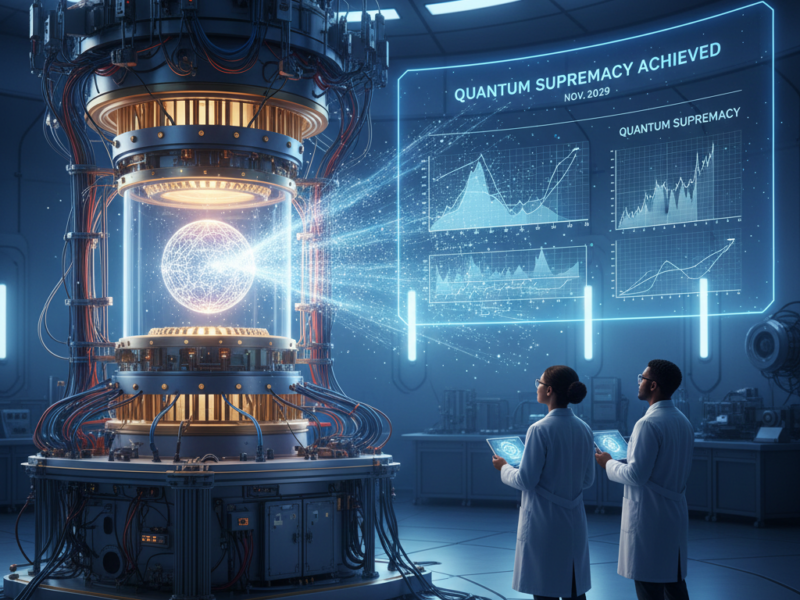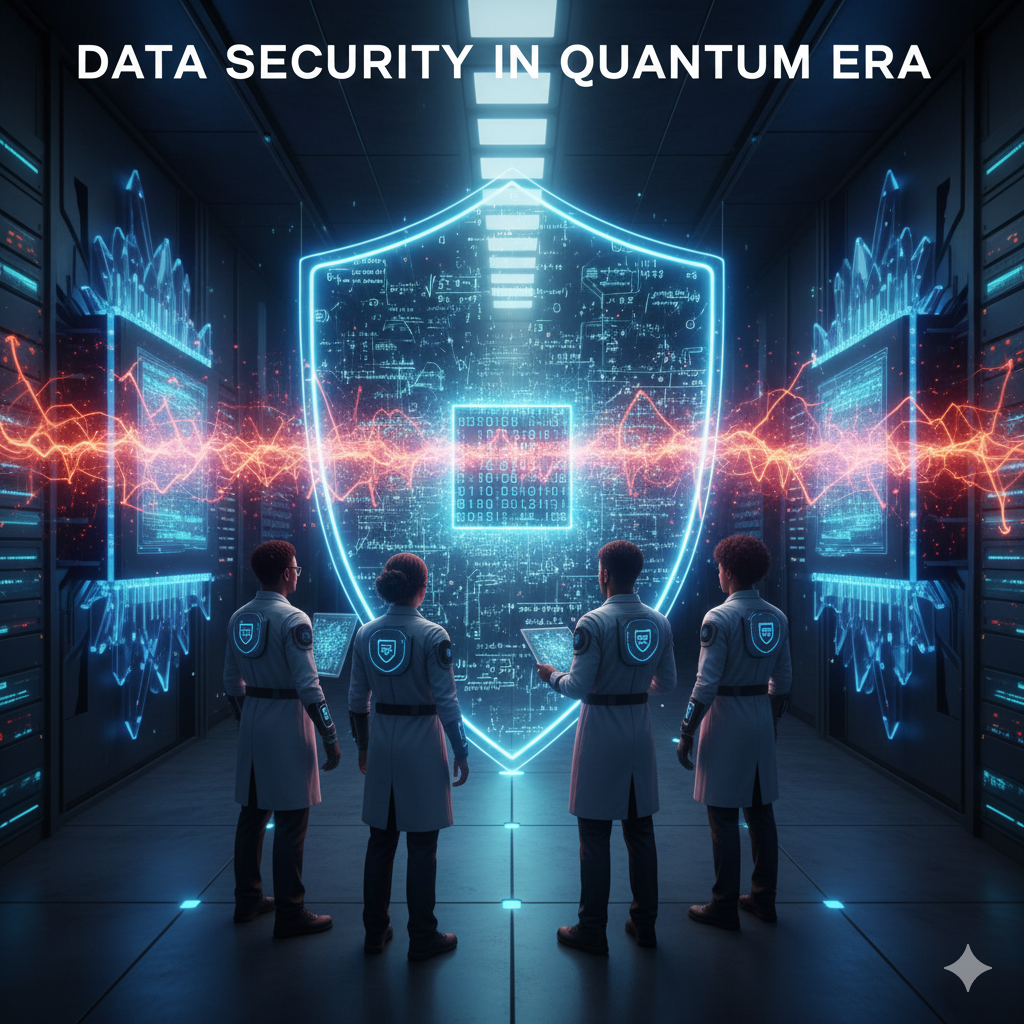
The year 2026 has brought humanity to a critical crossroads in the history of information technology. For decades, our global financial systems, national security protocols, and personal privacy have relied on mathematical problems that are incredibly difficult for classical computers to solve. However, the rapid advancement of quantum computing has introduced a looming existential threat known as **”Q-Day”**—the day a quantum computer becomes powerful enough to break current encryption standards. In 2026, **Data Security in the Quantum Era** is no longer a futuristic concern; it is an urgent priority. As quantum supremacy becomes a reality, we are witnessing a massive global transition toward cryptographic systems that can withstand the subatomic power of quantum processing.
The Quantum Threat: Why Current Encryption is Dying
Traditional encryption methods, such as RSA and ECC, rely on the difficulty of factoring large numbers or solving elliptic curve discrete logarithms. A classical supercomputer would take thousands of years to crack these codes. A quantum computer, utilizing **Shor’s Algorithm**, can perform these calculations in mere minutes. In 2026, this capability is forcing every government and corporation to rethink their defense strategies, as “Store Now, Decrypt Later” attacks become a major risk for sensitive historical data.
1. The “Harvest Now, Decrypt Later” Strategy
One of the most dangerous trends in 2026 is the harvesting of encrypted data by hostile actors. Even if they cannot crack the data today, they are storing it in anticipation of more powerful quantum computers arriving in the next few years. This means that data stolen in 2026 could expose top-secret information by 2030 if it is not protected using quantum-resistant algorithms today. This reality has made “Quantum Readiness” a core metric for corporate compliance.
Vulnerability of Blockchain and Digital Assets
The decentralized world is not immune. Many current blockchain protocols use signatures that are vulnerable to quantum attacks. In 2026, the crypto industry is racing to implement “Quantum-Hard” signatures to protect the billions of dollars stored in digital wallets. The security of the Web 3.0 era depends entirely on its ability to evolve beyond the vulnerabilities exposed by quantum mechanics.
The Shield: Post-Quantum Cryptography (PQC)
To counter the quantum threat, the National Institute of Standards and Technology (NIST) and global security agencies have finalized the first set of **Post-Quantum Cryptography (PQC)** standards in 2026. PQC refers to cryptographic algorithms—usually based on lattice-theory, code-based, or isogeny-based mathematics—that are thought to be secure against both quantum and classical computers.
2. Lattice-Based Cryptography: The New Standard
In 2026, lattice-based cryptography has emerged as the frontrunner for securing everyday internet traffic. Unlike RSA, which relies on simple number theory, lattice-based systems involve finding the shortest vector in a high-dimensional space—a problem that remains incredibly difficult even for a quantum computer. This technology is now being integrated into web browsers, VPNs, and secure messaging apps, ensuring that your 2026 communications remain “Quantum-Proof.”
3. Quantum Key Distribution (QKD)
While PQC is based on hard mathematics, **Quantum Key Distribution (QKD)** is based on the laws of physics. QKD uses entangled photons to create an unbreakable key between two parties. If an eavesdropper attempts to intercept the key, the quantum state of the photons collapses, immediately alerting the users to the breach. In 2026, major cities are building “Quantum Fiber Networks” specifically for high-stakes government and financial data transfers.
The Global Race for Quantum Sovereignty
In 2026, data security has become a matter of “Quantum Sovereignty.” Nations are investing billions to ensure they are the first to achieve a fully quantum-secure infrastructure. This race is reshaping geopolitical alliances, as countries that share “Quantum-Safe” protocols become the new trusted partners in the global economy. Organizations that fail to migrate to these new standards risk being permanently locked out of international trade and secure communications.
Conclusion: Building a Resilient Future
Data security in the Quantum Era is an ongoing marathon, not a sprint. As quantum computers grow in power, our defense mechanisms must continuously adapt. By embracing Post-Quantum Cryptography and the principles of Zero Trust, we can ensure that the transition to the quantum age is one of innovation rather than catastrophe. In 2026, the goal is clear: to create a digital world where data is so securely guarded that even the most powerful computer in the universe cannot break its seal. The quantum revolution is here, and our defenses are ready.