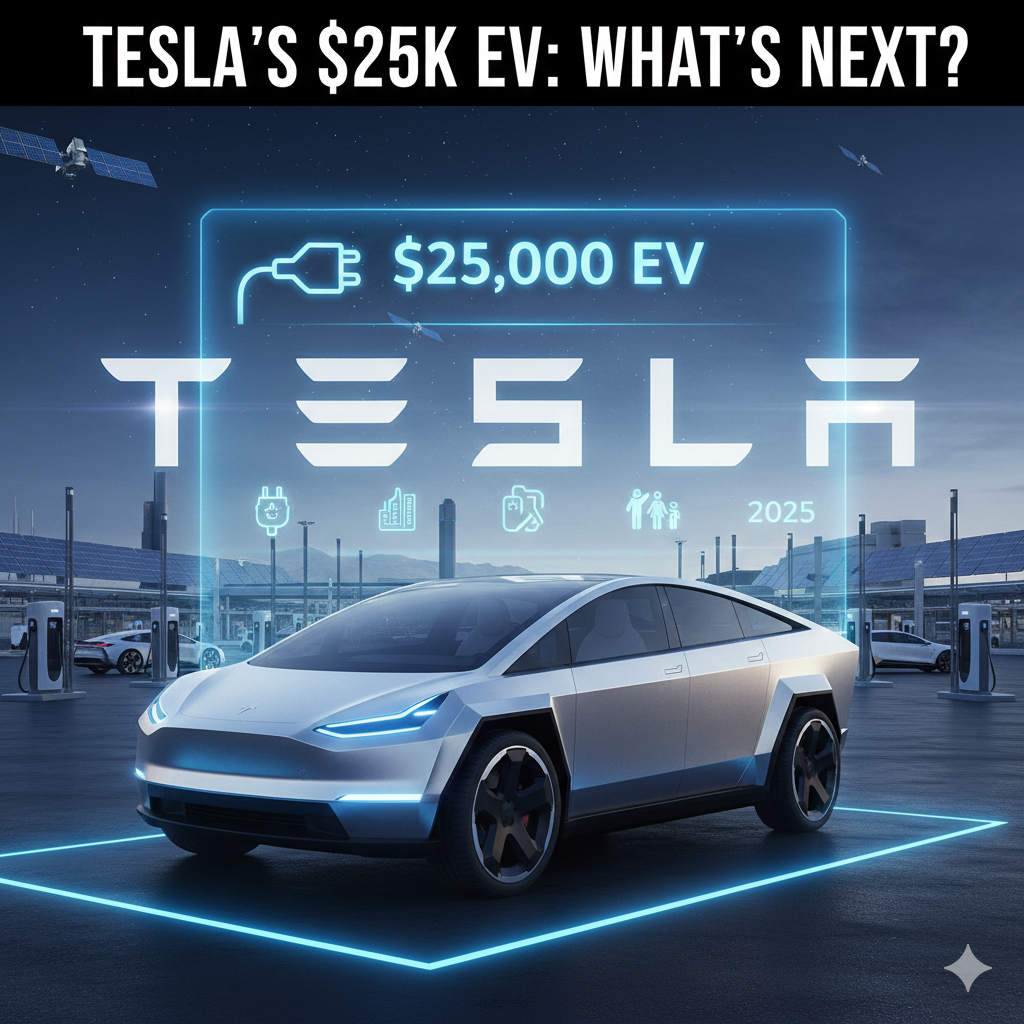

By early 2026, the global electric vehicle (EV) market has reached a critical tipping point. While Tesla has long dominated the premium and mid-range sectors, the world has been waiting for the “Next-Gen” platform—the elusive **$25,000 Tesla EV**. Often referred to in the industry as the “Model 2,” this vehicle is no longer just a promise on a slide deck; it is the cornerstone of Tesla’s strategy to achieve mass-market saturation. In 2026, the question is no longer “will they build it?” but “how will it change the world?” This affordable EV represents more than just a lower price tag; it is the debut of the “Unboxed” manufacturing process, a radical shift in automotive assembly designed to cut costs by 50% while maintaining the performance and tech-centric DNA that defines the Tesla brand. The $25k Tesla is the vehicle that aims to retire the internal combustion engine (ICE) for the average consumer once and for all.
The “Unboxed” Process: Manufacturing Reimagined
The secret behind the $25,000 price point in 2026 is Tesla’s revolutionary **Unboxed Manufacturing Process**. Traditional car assembly involves a linear line where parts are added to a frame. Tesla has discarded this 100-year-old method. In the new Gigafactories of 2026, the car is built in sub-assemblies simultaneously. The seats are bolted directly to the structural battery pack, and the front and rear sections are cast as single pieces using massive “Giga Presses.” These components only meet at the very end for final assembly. This reduces the factory footprint by 40% and drastically lowers the time and energy required to build each vehicle, allowing Tesla to maintain healthy profit margins even at a budget price.
1. Battery Innovation: LFP and Beyond
In 2026, the battery remains the most expensive component of an EV. For the $25k model, Tesla has utilized advanced **Lithium Iron Phosphate (LFP)** cells. These batteries are cheaper to produce, contain no cobalt or nickel, and are incredibly durable, capable of lasting for hundreds of thousands of miles with minimal degradation. Furthermore, Tesla’s integration of the structural battery pack—where the cells themselves act as the floor of the car—reduces weight and complexity, further driving down costs while improving the vehicle’s structural integrity and safety.
Full Self-Driving (FSD) as a Standard
Perhaps the most shocking aspect of the $25k Tesla in 2026 is that it is not a “stripped-down” car. Tesla has maintained that safety and autonomy are non-negotiable. Every $25k vehicle comes equipped with the latest HW5 (Hardware 5) suite, making it fully capable of the newest FSD features. Tesla’s strategy in 2026 is clear: sell the hardware at a low margin and generate long-term value through software-as-a-service (SaaS) and the emerging Robotaxi network. This makes the $25k Tesla not just a car, but a rolling computer that earns its keep.
The Impact on the Global Mass Market
The arrival of a high-quality, long-range $25k EV has sent shockwaves through the global automotive industry in 2026. Traditional manufacturers in Europe, Japan, and the US are being forced to accelerate their own budget EV programs or risk total obsolescence. The “Model 2” is particularly impactful in emerging markets where price sensitivity is high. It has effectively neutralized the advantage held by lower-cost competitors, proving that high-end technology and affordability can coexist in a single package.
2. Range and Performance: No Compromises
In 2026, the $25k Tesla offers an estimated range of 250 to 300 miles—more than enough for the average daily commute and weekend trips. Despite its price, the vehicle maintains the signature Tesla performance, with 0-60 mph times under 6 seconds. This ensures that the “entry-level” Tesla still feels like a Tesla, providing a driving experience that far exceeds anything available in the traditional sub-$30k gasoline market.
3. The Design Philosophy: Minimalist and Modern
Tesla has adopted a “Cyber-Minimalist” design language for the $25k platform. By utilizing a single-screen interface and removing physical buttons and complicated wiring harnesses, they have simplified the interior while creating a spacious, modern feel. In 2026, the focus is on utility and sustainability, with 100% vegan, recycled interior materials that are designed for durability and ease of cleaning—perfect for the ride-sharing and Robotaxi future Tesla is building.
What’s Next? The Future of the Platform
Looking beyond 2026, the $25k platform is the foundation for an entire family of vehicles. We are already seeing prototypes of a compact van and a dedicated Robotaxi built on this same high-efficiency architecture. Tesla’s goal is to produce 20 million vehicles per year by 2030, and the $25k EV is the primary engine that will drive that growth. It is the bridge between a niche luxury brand and a global energy and transport utility.
Conclusion: The Democratization of Autonomy
The $25,000 Tesla is more than a car; it is the democratization of the future. In 2026, it has proven that sustainable, autonomous, and high-performance transport is not a privilege for the wealthy, but a right for the many. By rethinking every aspect of how a car is designed, built, and sold, Tesla has delivered a product that solves the most pressing challenge of the green transition: accessibility. As the “Model 2” begins to flood the streets of the world, we are witnessing the final chapter of the age of oil and the beginning of a new, electric era for all.