The Beginning of Sky Watching and the Meaning of Astronomical Conjunction
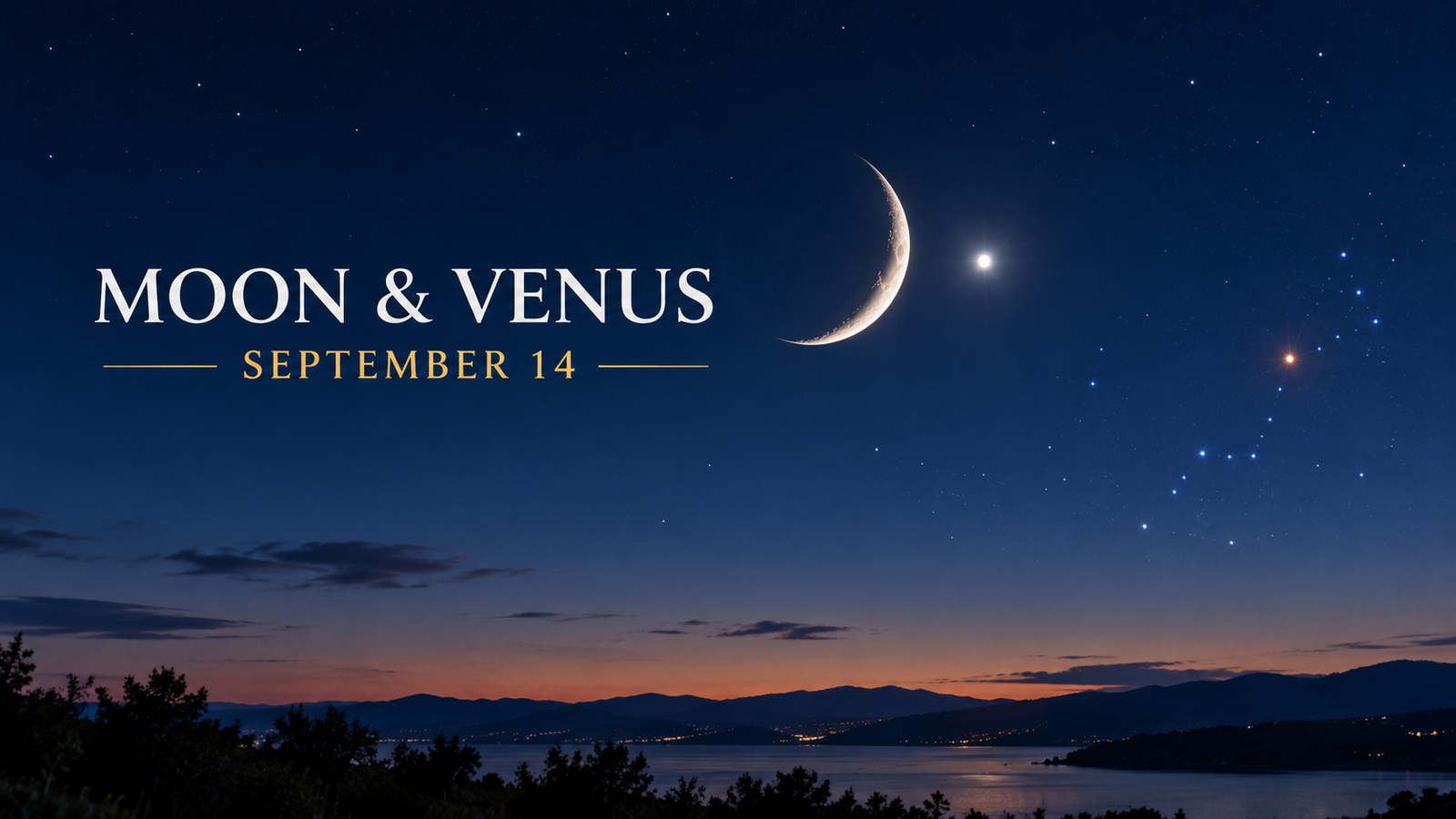
When the sun sets on the western horizon on the evening of September 14, casting its golden rays, a sight appears in the sky that has fascinated humanity for centuries. This spectacle is the conjunction of the Moon and Venus, scientifically known as a “conjunction.” It is the moment when two of the brightest celestial bodies in the sky come close to each other, making it look to observers on Earth as if they are talking or kissing each other. However, this alignment is merely an optical illusion because the Moon and Venus are actually millions of kilometers apart. The Moon is our closest neighbor in space, about 384,000 kilometers away, while Venus orbits the Sun at a distance of roughly 170 million kilometers from us. But when these two celestial bodies enter the same region of Earth’s sky, the perceived distance vanishes, presenting us with a breathtaking view.
This conjunction is also special because Venus will be near its peak brightness in September 2026. According to a report by NASA’s Jet Propulsion Laboratory, Venus will be at its brightest during this evening apparition on September 18, but it will be bright enough on September 14 to stand out distinctly from any other star in the sky. Venus is so bright that it is sometimes mistaken for an aircraft’s navigation light. On the astronomical scale, Venus’s magnitude reaches around negative 4.8, making it the second-brightest natural object in the night sky after the Moon. That is why on the evening of September 14, when the thin crescent moon and the glowing dot of Venus appeared together, the view was not only astronomically significant but also emotionally captivating.
Astronomical Conjunction and Its Scientific Reality
The term astronomical conjunction is actually used when two or more celestial bodies appear close together in the same part of the sky when viewed from Earth. This proximity is purely an optical illusion because the actual distance between these bodies in space is immense. As the Planetary Society explains, it is an event where planets and the Moon appear close to one another from Earth’s perspective, even though they are millions of miles apart in space. A simple way to understand this conjunction is to point your finger at a part of the sky and look at a distant mountain behind it. Your finger and the mountain will look close together from your viewpoint, but in reality, there is a vast distance between them. The case of the Moon and Venus is quite similar.
Another important aspect of this conjunction is that on September 14, 2026, a rare astronomical event known as an “occultation” occurred in specific regions. In this process, the Moon passes directly in front of Venus and temporarily hides it. According to the Bosscha Observatory in Indonesia, an occultation of Venus by the Moon took place on September 14, 2026, where the Moon passed between Earth and Venus, causing Venus to temporarily vanish behind the Moon’s disk. This view was fully visible only from specific parts of Indonesia, such as Sumatra, western Java, and parts of Borneo. However, people outside these regions only witnessed the close conjunction without the occultation. In Italy, this occultation occurred during daytime, where Venus slipped behind the Moon at 11:27 AM and reappeared one hour and twelve minutes later. Such occultation events are vital for astronomers because they provide an opportunity to measure the Moon’s orbit and surface accurately.
The Crescent Moon and Its Beauty
On September 14, 2026, the Moon was just a few days past its new phase, with only 14 to 16 percent of its surface illuminated. This is the slender crescent shape of the Moon that holds immense significance in the Islamic calendar, used to mark the beginning of a new month. According to reports from Bahrain, the Moon was in its crescent phase for Rabi al-Thani 1448 AH on this day, forming a rare celestial pair with Venus. This thin crescent shape looks especially gorgeous because of its delicacy, particularly when paired with a glowing planet like Venus.
Another interesting element on this occasion is the faint glow visible on the dark side of the Moon, known as “earthshine.” This light is actually reflected from Earth onto the Moon. When sunlight bounces off Earth’s surface back toward the Moon, the lunar portion not directly lit by the Sun glows faintly with this reflected light. On this night, the combination of the lunar crescent and earthshine made the view even more mesmerizing. This is a detail often overlooked but one that enhances the beauty of this astronomical spectacle.
The best time to view this thin crescent is about an hour after sunset, when the sky is not yet completely dark and a soft reddish or bluish hue lingers on the horizon. At this moment, both the Moon and Venus are close to the western horizon, making them easy to spot. If you have binoculars or a small telescope, you can even observe craters and mountains on the lunar surface, although only a small fraction of the Moon was lit that night.
The Brilliance and Importance of Venus
Venus, often called the “Evening Star” or “Morning Star,” is the second planet from our Sun and the brightest natural object in the night sky after the Sun and Moon. In September 2026, Venus was unusually bright during its evening display, reaching peak brilliance on September 18. Yet on September 14, it was bright enough to be easily spotted even amidst city lights. This brilliance of Venus is primarily due to its dense clouds, which reflect sunlight very effectively. Thick sulfuric acid clouds cover the surface of Venus, making it the most reflective planet in the solar system.
An interesting paradox regarding Venus’s brightness on this night was that although it was near peak brilliance, only about 22 percent of its illuminated surface was facing the Sun. Typically, when Venus shows a larger illuminated phase, it is farther from us and thus appears dimmer, whereas when it shows a smaller phase, it is closer and looks brighter. In late September, Venus was relatively close to Earth, and its large apparent size compensated for its thin crescent phase. This is why Venus shone like a brilliant diamond in the sky on the evening of September 14.
The Occultation of September 14: A Rare Astronomical Event
The day of September 14, 2026, was also memorable because of the lunar occultation of Venus, a rare cosmic phenomenon. An occultation happens when a larger celestial body passes in front of a smaller one, temporarily blocking it from view. The occultation of Venus by the Moon is special because Venus is much farther away than the Moon, yet from Earth’s vantage point, the Moon completely covers it. This phenomenon was viewed differently across various parts of the world.
In Indonesia, according to the Bosscha Observatory, the occultation was observed between roughly 7:30 PM and 8:30 PM. People in specific Indonesian regions witnessed Venus vanishing behind the Moon and reappearing later, a moment that left astronomy enthusiasts amazed. In Assam, India, people also witnessed the event, describing how Venus appeared to merge with the Moon. In Italy, the occultation took place during the daytime, with Venus hiding behind the Moon at 11:27 AM and emerging 72 minutes later. Since it occurred during daylight, it could not be seen with the naked eye and required optical instruments like telescopes.
Best Times and Methods for Observation
The optimal time to observe this astronomical spectacle on the evening of September 14, 2026, was about an hour after sunset. At this time, the twilight sky still held a soft glow on the western horizon, making both the Moon and Venus easy to locate. Astronomers recommended keeping your gaze directed toward the western or south-western horizon. If you possessed binoculars or a small telescope, you could inspect the details of the lunar surface and Venus’s crescent phase.
Weather conditions played a major role that night. The eastern parts of the United States experienced clear skies with almost no clouds, offering an exceptional view. However, heavier cloud cover in western regions created obstacles for observers. Clear skies and low-light environments are crucial for such astronomical events. Moving away from urban light pollution to an open field or hilltop offers the best viewing experience.
Cultural and Historical Significance
The conjunction of the Moon and Venus is not just a scientific event; it carries deep cultural and historical significance. In many cultures, both celestial bodies hold a special place. In Islamic tradition, the sighting of the crescent moon marks the beginning of a new month, guiding religious months and observances. In ancient civilizations, Venus was associated with the goddess of love and beauty—named “Venus” in Roman mythology, a title the planet retains today.
Some people likened the night’s view to the classic “crescent and star” symbol found on the flags and emblems of several Islamic nations. News outlets in Indonesia referred to this view as “Bulan Bintang” (Moon and Star), which aligns with national symbolism. Historically, records of Moon-Venus conjunctions date back to ancient writings. Ancient astronomers meticulously tracked the motion of these bodies to build calendars, and modern researchers still use these historical records to study long-term variations in Earth’s rotation.
Other Astronomical Events of September 2026
The September 14 conjunction was part of a packed lineup of astronomical occurrences in September 2026. According to NASA, several notable sights graced the month. Between September 14 and 20, the Moon served as a guide to locate stars and constellations, such as Antares—the fiery red heart of Scorpius—and the Milky Way’s galactic center under dark skies. On September 18, Venus reached its peak evening brilliance. Following that, the autumn equinox arrived on September 22, balancing day and night, and the “Harvest Moon” rose on September 26, accompanied closely by Saturn in the night sky.
Scientific Importance of Astronomical Sights
Astronomical phenomena like the Moon-Venus conjunction are far more than just pretty scenery; they hold profound scientific value. Studying these alignments helps scientists measure the Moon’s orbit, surface properties, and the structure of Venus’s atmosphere. Observing light variations during an occultation allows researchers to analyze the thickness and composition of Venus’s cloud layers. Furthermore, tracking occultations helps refine lunar orbital data and improves our understanding of the Earth-Moon distance.
Conclusion: Celestial Beauty and Our Place in the Universe
The Moon-Venus conjunction on the evening of September 14, 2026, brilliantly merged scientific significance, cultural meaning, and aesthetic beauty. The slender lunar crescent paired with the gleaming point of Venus offered a view that has mesmerized humanity for ages. It serves as a gentle reminder that we are a small part of a vast cosmos and that the infinite expanse of the sky far exceeds our worldly existence. Such cosmic events pull us away from daily routines, inviting us to lift our eyes and appreciate the timeless wonder of the universe.