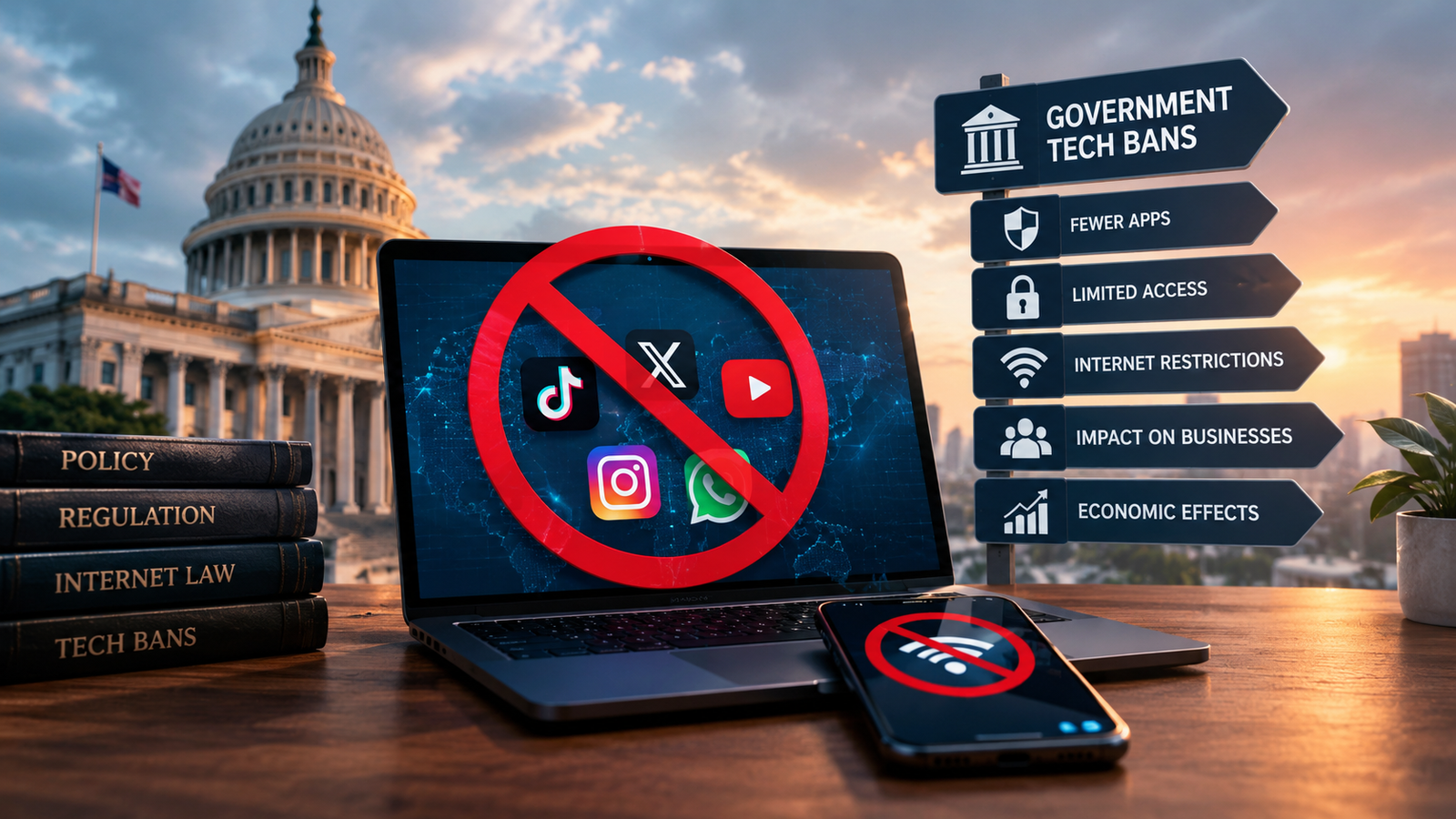
How Government Tech Bans Affect You
Key Takeaways
- Government tech bans usually target national security, data privacy, competition, or child-safety concerns — not the technology itself.
- Bans can cut off access to apps overnight, disrupt supply chains, and force companies to redesign products for specific markets.
- Everyday users feel the impact through lost app access, higher prices, and pressure to use riskier workarounds like unofficial VPNs.
- Businesses face rising compliance costs and a more fragmented, region-by-region internet.
- Understanding why a ban happens helps you prepare — rather than react in a panic once it’s already in effect.
In the past few years, headlines about a government “banning” a piece of technology have gone from rare to routine. A messaging app disappears from an app store overnight. A telecom company can no longer sell certain hardware. A social platform is forced to divest from its parent company or leave a country entirely. For most people, these stories can feel distant — until the ban touches something they use every day.
This article breaks down what a government tech ban actually is, why they happen, and — most importantly — how they ripple outward to affect ordinary users, small businesses, developers, and the wider economy, long after the news cycle has moved on.
What Counts as a “Government Tech Ban”?
The term covers more ground than it first appears. A tech ban isn’t always a blunt, total block. In practice, it usually falls into one of a few categories:
- Outright prohibition — a specific app, device, or service is made illegal to distribute or use within a jurisdiction.
- Government-device restrictions — an app is banned only on government-owned phones and networks, often as a first, narrower step.
- Forced divestiture — a foreign-owned platform must sell its local operations to a domestic buyer or face removal.
- Import and export controls — specific hardware, chips, or components cannot be sold to or bought from certain countries or companies.
- Conditional access — a service can continue operating, but only if it meets new requirements such as local data storage, age verification, or content moderation standards.
Each of these has a different blast radius. An outright ban affects everyone in a country immediately. A conditional access rule might only be noticeable to a business trying to stay compliant. Understanding which type of ban you’re dealing with is the first step to understanding how it will actually affect you.
Why Governments Ban Tech Products and Platforms
Bans rarely happen for a single, simple reason. Most are the result of overlapping pressures — political, economic, and social — building up over time. The most common justifications fall into five buckets.
1. National Security Concerns
This is the most frequently cited reason, especially for hardware and telecom equipment. Governments worry that foreign-made networking equipment, apps with broad data access, or cloud infrastructure controlled abroad could be used for surveillance, data collection, or even remote sabotage during a conflict. Whether or not a specific risk is ever proven publicly, the perception of risk alone is often enough to trigger regulatory action.
2. Data Sovereignty and Privacy
Many countries have grown uncomfortable with citizen data flowing to servers outside their borders, particularly to jurisdictions with different privacy standards or weaker legal protections. Bans and restrictions in this category are often framed around where data is stored and who can legally request access to it.
3. Child Safety and Public Health
Age-verification rules and outright bans for younger users on certain platforms have become more common as governments respond to concerns about mental health, addictive design patterns, and exposure to harmful content. These bans tend to target features or age groups rather than the entire platform.
4. Trade and Economic Competition
Export controls on advanced chips, restrictions on foreign telecom equipment, and tariffs on tech hardware are often as much about protecting domestic industries and maintaining a competitive or strategic edge as they are about direct security threats.
5. Antitrust and Market Fairness
Some restrictions aren’t bans in the traditional sense but structural remedies — forcing a dominant platform to open up its app store, interoperate with competitors, or separate business units that regulators believe are stifling competition.
A ban is rarely just about the technology itself — it’s usually a visible symptom of a much larger negotiation between governments, companies, and the public over control of data and infrastructure.
Real-World Patterns Worth Understanding
Rather than focusing on any single event, it helps to recognize the recurring patterns that show up across different countries and different technologies.
Social Media and Messaging Apps
Short-video and messaging platforms have repeatedly found themselves at the center of national security and data-privacy debates, especially when a platform’s parent company is based in a country seen as a geopolitical rival. The typical progression is: government device restrictions first, followed by public debate, followed — in some cases — by broader restrictions or forced ownership changes.
Telecom and Networking Hardware
Restrictions on foreign-made 5G equipment and networking hardware have become a recurring feature of trade policy, with governments requiring telecom operators to remove or avoid certain vendors’ equipment from critical infrastructure, citing long-term security risk over the equipment’s operational lifespan.
Semiconductor and Chip Export Controls
Advanced chip technology has become one of the most tightly controlled categories of trade, with export licensing requirements affecting which companies can sell high-performance processors and manufacturing equipment across borders. These controls affect everything from AI research to the price of consumer electronics.
VPNs, Encrypted Messaging, and Circumvention Tools
In markets with strict internet controls, VPNs and encrypted messaging apps are frequently targeted directly, since they’re the primary tools people use to route around other restrictions. This creates a continuous back-and-forth between regulators and the tools designed to bypass them.
Age Verification and Under-16 Access Rules
Several countries have introduced or proposed minimum-age requirements for social media access, requiring platforms to verify user age through more robust methods than a simple checkbox — a shift that affects both platform design and how much personal data users must provide to prove their age.
How This Affects Everyday Users
For most people, the effects of a tech ban show up in a handful of very practical ways:
- Sudden loss of access — an app you rely on for work, communication, or income (as a creator, for instance) can be removed from app stores with little warning.
- Data portability headaches — years of photos, contacts, messages, or business connections built on one platform may become difficult or impossible to fully export before access ends.
- Higher prices on hardware — chip and component restrictions tend to raise manufacturing costs, which are eventually passed on to consumers buying phones, laptops, and other devices.
- Pressure to use riskier workarounds — when access is cut off, some users turn to unofficial VPNs or sideloaded apps from unverified sources, which can introduce real security and privacy risks of their own.
- New verification requirements — age-verification and identity-check rules mean handing over more personal information just to keep using a familiar service.
The common thread is that users are rarely the intended target of a ban, but they absorb most of the day-to-day inconvenience.
How This Affects Businesses
For companies — from global enterprises to small online sellers — tech bans introduce a different kind of pressure: operational and financial uncertainty.
- Compliance costs — meeting data localization or age-verification requirements often means rebuilding infrastructure on a country-by-country basis rather than running a single global system.
- Supply chain disruption — hardware and component restrictions can suddenly make a previously reliable supplier unusable, forcing companies to requalify new vendors under time pressure.
- Marketing and customer-acquisition risk — businesses that built an audience primarily on one banned or restricted platform can lose access to customers overnight.
- Market fragmentation — as more countries impose their own rules, companies increasingly need separate product versions, data centers, and legal review processes for different regions instead of one global rollout.
The businesses that adapt most smoothly tend to be the ones that diversified their platforms and infrastructure well before a ban became a serious possibility, rather than after.
How This Affects Developers and Startups
Smaller technology companies and independent developers often feel these shifts even more acutely than large enterprises, since they typically lack the legal and engineering resources to adapt quickly.
- App store removal risk — a single policy change can remove an app’s primary distribution channel in a key market.
- Restricted API access — platforms sometimes tighten API access for developers based in or serving certain regions, breaking existing integrations.
- Data localization burdens — a startup with customers in a country requiring local data storage may need to stand up new infrastructure there long before it’s otherwise ready to expand.
- Investor caution — regulatory uncertainty in a target market can make it harder to raise funding for products that depend heavily on cross-border data flow.
The Legal and Political Process Behind a Ban
Bans don’t usually appear out of nowhere. They typically follow a recognizable sequence: a security review or investigation, public hearings or statements from officials, a proposed rule or bill, a comment period, and then formal enforcement — often followed immediately by legal challenges from the affected companies. This process can take months or years, which means that attentive users and businesses often have real warning before a ban takes full effect, if they know where to look — official government notices, telecom regulator announcements, and reporting from established technology and policy outlets.
How to Protect Yourself and Your Business
While you can’t control government policy, you can reduce how exposed you are to any single decision.
- Diversify your platforms. Avoid building your entire audience, workflow, or customer base around a single app or service, especially one facing regulatory scrutiny in your region.
- Back up your data regularly. Export contacts, messages, and business data on a routine schedule rather than waiting until a shutdown notice appears.
- Follow official channels, not rumors. Rely on government regulator websites and established news sources rather than social media speculation when a ban is being discussed.
- Use verified, mainstream tools. If you need a VPN or alternative service, choose established providers with transparent privacy practices instead of unknown apps promising to “unblock everything.”
- Build compliance into your product early. For businesses, treating data localization and privacy requirements as a core design consideration — rather than an afterthought — makes adapting to new rules far less disruptive.
Frequently Asked Questions
Can a government really ban an app overnight?
In most cases, no — bans usually follow a formal legal and regulatory process that takes months. However, enforcement (such as removal from app stores) can happen quickly once that process concludes, which is why it can feel sudden to users who weren’t following the earlier stages.
Is it safe to use a VPN to access a banned app?
This depends entirely on local law, which varies significantly by country. Beyond the legal question, using an unverified VPN also introduces its own privacy and security risks, since your traffic is routed through a third party you may not fully trust.
Do tech bans only affect large companies?
No. Small businesses and individual creators who rely on a single platform for sales or audience reach are often more exposed than large companies, which typically have more resources to adapt quickly.
Conclusion
Government tech bans are no longer rare, isolated events — they’re becoming a regular feature of how technology, trade, and national policy intersect. For everyday users, that means occasional disruption and new verification steps. For businesses and developers, it means building more resilient, adaptable systems instead of depending on any single platform or market. Understanding why these bans happen — and recognizing the warning signs before they take effect — is the most practical way to stay ahead of a trend that isn’t slowing down anytime soon.