Apple is one of the most valuable and recognisable technology companies in the world. Famous for the iPhone, Mac, iPad, Apple Watch and AirPods, it also runs a fast-growing services business that includes the App Store, iCloud, Apple Music and Apple Pay. Its products are used on more than two billion active devices worldwide.
In this company profile, we look at the company’s history, its founders and leaders — including the 2026 handover from Tim Cook to John Ternus — how it makes money, its record fiscal 2026 results, its approach to privacy and AI, its competitors and the challenges ahead.
🍎 Key Takeaways
- Founded in 1976 by Steve Jobs, Steve Wozniak and Ronald Wayne; headquartered in Cupertino, California.
- John Ternus became CEO on 1 September 2026, with Tim Cook moving to executive chairman.
- Fiscal 2026 revenue reached a record $478.8 billion, up from $416.2 billion in 2025.
- The iPhone generated $254.1 billion, and Services reached a record $123.3 billion.
- Privacy, custom chips and a tightly connected ecosystem are the company’s biggest strengths.
Apple Company Overview
| Founded | 1 April 1976 |
| Founders | Steve Jobs, Steve Wozniak, Ronald Wayne |
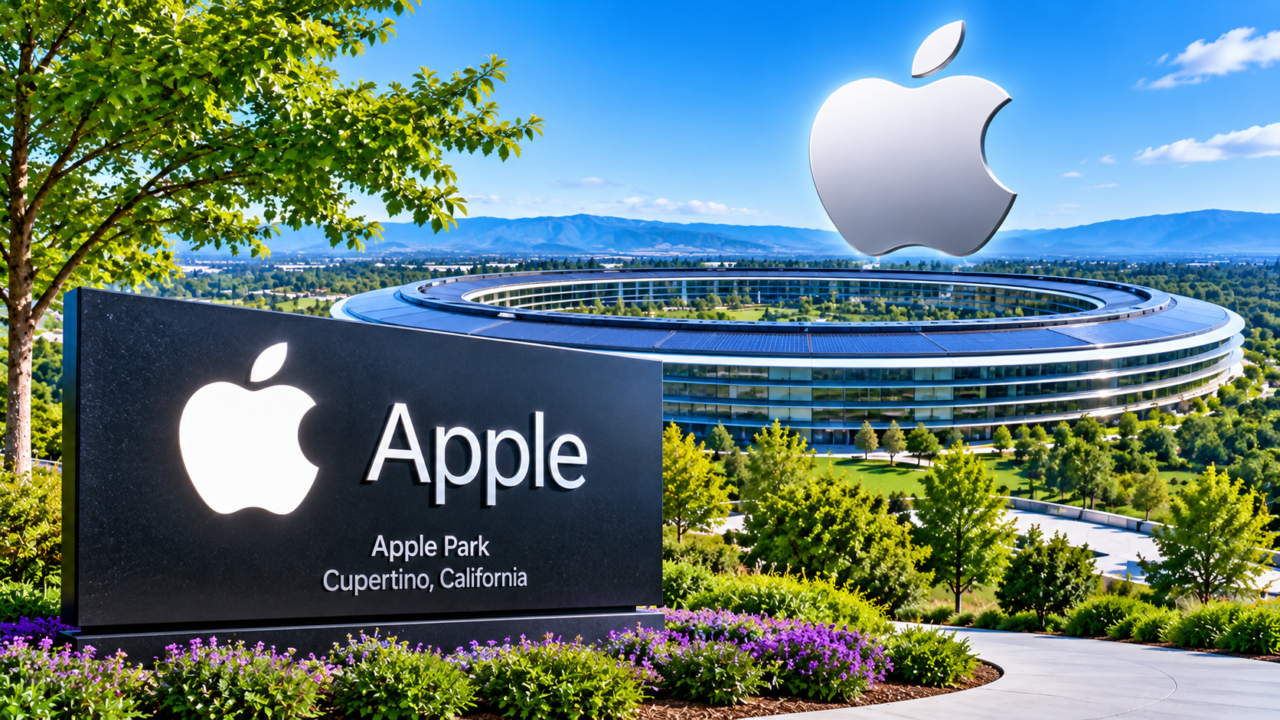
| Headquarters | Apple Park, Cupertino, California |
| CEO | John Ternus (since September 2026) |
| Executive Chairman | Tim Cook |
| Stock listing | Nasdaq: AAPL |
| FY2026 revenue | $478.8 billion |
| Key products | iPhone, Mac, iPad, Apple Watch, AirPods, Vision Pro |
Apple by the Numbers
History of Apple
The company was founded on 1 April 1976 by Steve Jobs, Steve Wozniak and Ronald Wayne. Wozniak built the Apple I computer by hand, and Jobs saw the chance to sell it. Wayne left within days, selling his stake for a few hundred dollars. In 1977 the Apple II became one of the first successful mass-market personal computers.
In 1984 the company launched the Macintosh, which made the graphical user interface and mouse popular with ordinary users. But internal conflicts led to Jobs leaving in 1985. During the 1990s the business struggled, and by 1997 it was close to bankruptcy.
That year, it bought Jobs’s company NeXT, and Jobs returned as leader. What followed is one of the greatest turnarounds in business history: the colourful iMac (1998), the iPod and iTunes (2001), the iPhone (2007), the App Store (2008) and the iPad (2010). Jobs stepped down in August 2011 and died in October that year. Tim Cook, his chief operating officer, became CEO.
Key Milestones
| Year | Milestone |
|---|---|
| 1976 | Company founded; Apple I released |
| 1977 | Apple II launched |
| 1980 | Initial public offering |
| 1984 | Macintosh launched |
| 1997 | NeXT acquired; Steve Jobs returns |
| 2001 | iPod and first Apple retail stores |
| 2007 | iPhone launched |
| 2008 | App Store opens |
| 2010 | iPad launched |
| 2011 | Tim Cook becomes CEO |
| 2015 | Apple Watch launched |
| 2020 | Macs move to Apple silicon (M1 chip) |
| 2024 | Vision Pro and Apple Intelligence introduced |
| 2026 | John Ternus becomes CEO; record $478.8B revenue |
Apple Leadership: From Tim Cook to John Ternus
Under Tim Cook, the company grew into a services and wearables giant and became the first US company to reach a $1 trillion, $2 trillion and then $3 trillion market value. Revenue rose many times over during his 15 years as CEO, and his background in supply chain management helped build one of the most efficient manufacturing networks in the world.
In April 2026, the board announced that Cook would step down as CEO and become executive chairman. John Ternus, senior vice president of Hardware Engineering, took over as CEO on 1 September 2026. Ternus joined the product design team in 2001 after studying mechanical engineering at the University of Pennsylvania. He helped lead hardware for the iPad, AirPods, recent iPhones and the move of the Mac to Apple silicon.
Other key leaders include Chief Operating Officer Sabih Khan, Chief Financial Officer Kevan Parekh and software chief Craig Federighi.
Apple Products and Services
Hardware
- iPhone: the flagship product and biggest source of revenue. The 2026 line-up includes the iPhone 18 Pro, iPhone 18 Pro Max and the new iPhone Duo.
- Mac: MacBook Air, MacBook Pro, iMac, Mac mini, Mac Studio and Mac Pro, all powered by M-series chips.
- iPad: tablets from the entry-level iPad to the iPad Pro.
- Wearables, Home and Accessories: Apple Watch, AirPods, HomePod, Apple TV and the Vision Pro headset.
Services
- App Store: millions of apps, with the company taking a commission on many purchases.
- iCloud+: cloud storage and privacy features. Learn the basics in our guide to cloud computing.
- Subscriptions: Music, TV+, Arcade, Fitness+ and the One bundle that combines them.
- Payments: digital wallet payments, a credit card and peer-to-peer cash transfers.
- Advertising and licensing: search ads in the App Store and fees from search engine partners.
💡 Did you know? Ronald Wayne, the third co-founder, sold his 10% stake for just $800 in 1976. That stake would be worth hundreds of billions of dollars today.
How Apple Makes Money
The iPhone is still the engine of the business, bringing in more than half of total revenue. But the company’s real strength is its ecosystem: once customers own an iPhone, they often buy a Mac, AirPods or Apple Watch and pay for services such as iCloud storage and Apple Music. These devices work seamlessly together, making it harder for users to switch to rivals.
Services have become especially important because they earn much higher profit margins than hardware and bring in steady, recurring income from the huge installed base of devices.
Apple Financial Performance
The company’s fiscal year ends in late September. Fiscal 2026 (ended 26 September 2026) was its best year ever:
| Category | FY2025 | FY2026 |
|---|---|---|
| iPhone | $209.6B | $254.1B |
| Services | $109.2B | $123.3B |
| Mac | $33.7B | $37.9B |
| iPad | $28.0B | $27.9B |
| Wearables, Home & Accessories | $35.7B | $35.6B |
| Total revenue | $416.2B | $478.8B |
In the fourth quarter alone, revenue rose 12% to $114.5 billion, with net income of $30.7 billion. iPhone revenue reached a September-quarter record of $57.6 billion, and Services hit an all-time high of $31.6 billion. It was John Ternus’s first earnings report as CEO. You can read the full figures on the company’s official investor relations page.
Figures from official earnings releases. This is not investment advice.
Apple Silicon: The Chip Advantage
One of the company’s most important moves of the past decade was designing its own processors. The A-series chips power iPhones, while M-series chips replaced Intel processors in Macs starting in 2020. These chips deliver strong performance with excellent battery life, and they give the company more control over its products and costs.
The chips are manufactured by TSMC, the Taiwanese foundry that also makes processors for companies such as NVIDIA. Apple has also started designing its own modem and wireless chips to reduce reliance on suppliers.
Apple, Privacy and Security
The company has made privacy a central part of its brand, with the slogan “Privacy. That’s iPhone.” Features include App Tracking Transparency, which lets users stop apps from tracking them across other apps; on-device processing of personal data; end-to-end encryption for iMessage and many iCloud categories; and Advanced Data Protection for even stronger encryption.
It also supports passkeys across its devices, helping users replace passwords with Face ID or Touch ID. Learn why this matters in our guide to multi-factor authentication. Privacy rules around the world, including the GDPR, affect how apps and websites handle data — see our guide to GDPR compliance.
Apple Intelligence and AI Strategy
The company was seen as slower than rivals in generative AI. In 2024 it introduced Apple Intelligence, a set of AI features for writing, image creation, notification summaries and a smarter Siri, with a focus on running AI on the device or through its Private Cloud Compute servers to protect privacy.
Upgrading Siri took longer than planned, but the company has continued to expand its AI features, including partnerships with outside AI model providers. Learn how these technologies work in our guide to generative AI.
Design Philosophy and Customer Experience
Design has been at the heart of the company since the early days. Steve Jobs insisted that products should be simple, beautiful and easy to use, and long-time design chief Jony Ive shaped icons such as the iMac, iPod and iPhone. Today, hardware and software teams work closely together so that every detail — from the feel of a button to the animation on a screen — fits into one consistent experience.
This attention to detail extends to how products are sold and supported. The company operates more than 500 retail stores around the world, where customers can try devices, attend free creative sessions and get help at the Genius Bar. Its online store, support app and trade-in programmes make upgrading easy, which helps keep customers loyal for many years.
Environmental and Social Goals
The company has set a goal to become carbon neutral across its entire supply chain and product life cycle by 2030. It uses more recycled materials such as aluminium, cobalt and rare earth elements, has removed plastic from most packaging and runs its own offices, stores and data centres on renewable electricity. Recycling robots disassemble old iPhones to recover valuable materials.
It also faces scrutiny over labour conditions at supplier factories, repairability of its devices and the environmental impact of frequent upgrades. In response, it publishes yearly supplier responsibility reports, has expanded self-service repair options and offers longer software support for older devices than many rivals.
What the Company Means for Developers and Creators
The App Store has created a huge economy for software developers, from small indie studios to global brands. Developers use tools such as Xcode and the Swift programming language to build apps for phones, tablets, computers, watches and headsets. Small businesses with low annual revenue can qualify for a reduced commission rate, while larger developers pay standard fees on many digital purchases.
For bloggers, video creators and website owners, iPhone users are an important audience. They are known for high engagement and spending, which makes them valuable for advertisers. At the same time, privacy features such as App Tracking Transparency and Safari’s tracking protection have changed how online ads are targeted and measured, pushing publishers to rely more on first-party data, contextual ads and strong content quality.
Legal and Regulatory Challenges
- EU Digital Markets Act: rules in Europe forced the company to allow alternative app stores and payment options, and it has been fined over App Store anti-steering rules.
- US antitrust case: the US Department of Justice sued in 2024, accusing the company of monopolising the smartphone market.
- App Store fees: court rulings in the Epic Games case have pushed it to let developers link to outside payment options in the US.
- Google search deal: payments from Google for being the default search engine on Safari came under scrutiny in the US search antitrust case. Read more in our Alphabet company profile.
- AI rules: new laws such as the EU AI Act shape how AI features can be offered in Europe.
Apple Supply Chain and Manufacturing
Its products are designed in California, but the company relies on partners such as Foxconn to assemble them. For years most production happened in China, but it has been shifting more manufacturing to India and Vietnam to reduce risks from trade tensions and tariffs. India is now a major production base for iPhones sold in the United States. The company has also announced large investment plans in US manufacturing and chip supply.
Apple Competitors
| Area | Main competitors |
|---|---|
| Smartphones | Samsung, Google Pixel, Xiaomi, Huawei, Oppo, Vivo |
| Computers | Microsoft Windows PC makers (Dell, HP, Lenovo) |
| Tablets | Samsung Galaxy Tab, Amazon Fire, Microsoft Surface |
| Wearables | Samsung Galaxy Watch, Google Fitbit, Garmin |
| Services | Spotify, Netflix, Google, Amazon |
| AI assistants | Google Gemini, OpenAI ChatGPT, Amazon Alexa |
Several of these rivals have their own profiles on our site, including Microsoft and Amazon.
Strengths and Challenges
Strengths:
- One of the world’s most valuable brands with loyal customers
- Tightly integrated hardware, software and services
- Custom silicon that delivers performance and efficiency
- High-margin, fast-growing services business
- Strong reputation for privacy and security
Challenges:
- Heavy dependence on iPhone sales
- Regulatory pressure on the App Store and default search deals
- Catching up with rivals in generative AI
- Supply chain concentration in Asia and tariff risks
- Competition from Chinese smartphone brands
The Future of Apple
Under John Ternus, the company is expected to focus on new hardware categories and deeper AI integration. Key areas to watch include new iPhone designs such as the iPhone Duo, the first touchscreen Macs, smart home devices, the upgraded Siri, mixed-reality headsets and health features. With record results in fiscal 2026 and an installed base of more than two billion devices, it enters this new era from a position of strength.
Apple FAQs
Who is the CEO of Apple?
John Ternus has been CEO since 1 September 2026. He succeeded Tim Cook, who became executive chairman of the board.
Who founded Apple?
Steve Jobs, Steve Wozniak and Ronald Wayne founded the company on 1 April 1976.
Where is Apple headquartered?
Its headquarters is Apple Park in Cupertino, California.
How much revenue did Apple make in 2026?
The company reported a record $478.8 billion in revenue for fiscal 2026, which ended on 26 September 2026.
What is Apple’s biggest product?
The iPhone is its biggest product, generating $254.1 billion in fiscal 2026 — more than half of total revenue.
How does Apple make money from services?
Services revenue comes from App Store commissions, iCloud storage, subscriptions like Apple Music and Apple TV+, Apple Pay, advertising and licensing deals.
Does Apple make its own chips?
Yes. It designs its own A-series and M-series chips, which are manufactured by TSMC.
Who are Apple’s main competitors?
Major rivals include Samsung, Google, Microsoft, Xiaomi, Huawei and Amazon, depending on the product category.
Conclusion
Apple has grown from a garage start-up into one of the most influential companies in history. The iPhone remains its powerhouse, while services, wearables and custom chips have made the business more diverse and profitable. Record fiscal 2026 results show the strength of its ecosystem, even as regulators and AI competition create new challenges. With John Ternus now in charge, the next chapter will test whether the company can deliver the next generation of breakthrough products.
🏢 Explore more: Read more profiles in our Tech Companies section.
Sources: Apple fiscal 2026 fourth quarter results; Apple leadership announcements (April and September 2026). This article is for general information only and is not investment advice.